Eid al-Fitr 2026, which marks the end of the month of Ramadan, is one of the two great festivals of Islam. This day is devoted to gratitude to Allah, prayer, family reunions and sharing.
The date of Eid al-Fitr depends on the lunar calendar and on the start of the month of Shawwal. Depending on official announcements and the sighting of the crescent moon, the date may differ slightly from one country to another.
This article presents the date of Eid al-Fitr 2026, its meaning, zakat al-fitr, the main practices of the day and the greetings traditionally used.
Contents
- When was Eid al-Fitr 2026?
- The meaning of the end of Ramadan
- Zakat al-fitr, an obligatory charity before the prayer
- The traditional course of Eid day
- Traditional greetings and wishes
- Preparing well for the day of celebration
- Frequently asked questions
When was Eid al-Fitr 2026?
Eid al-Fitr falls on the first day of the month of Shawwal, which follows Ramadan. Its date depends on the method used to establish the start of the new lunar month: sighting of the crescent or astronomical calculation, depending on the authorities and the country.
In France, the Grand Mosque of Paris set the start of Ramadan 2026 on Wednesday 18 February and Eid al-Fitr on Friday 20 March 2026. In Morocco, the Ministry of Habous and Islamic Affairs set 1 Ramadan on Thursday 19 February and Eid al-Fitr on Friday 20 March 2026. In other countries, the date may have differed by a day depending on the method used (sighting of the crescent or astronomical calculation).
The meaning of the end of Ramadan
Eid al-Fitr is the festival that marks the end of the month of Ramadan.
The word “fitr” refers to breaking the fast. After a month devoted to fasting, prayer, reading the Quran and supplication, Muslims celebrate this day with gratitude and joy.
Eid al-Fitr is one of the two annual religious festivals of Islam, along with Eid al-Adha.
The day is not simply a celebration of the end of fasting. It is also marked by the Eid prayer, zakat al-fitr, visits to relatives, greetings and the strengthening of family ties.
The Prophet ﷺ established two days of celebration for Muslims: Eid al-Fitr and Eid al-Adha.
Zakat al-fitr, an obligatory charity before the prayer
Zakat al-fitr, also called sadaqat al-fitr, is a charity linked to the end of Ramadan.
Ibn Umar (may Allah be pleased with them both) reported that the Prophet ﷺ made zakat al-fitr obligatory on Muslims: one sa’ of dates or one sa’ of barley, for men and women, free and enslaved, young and old (Sahih al-Bukhari 1503). Abu Sa’id al-Khudri also mentions a sa’ of food (Sahih al-Bukhari 1506). Ibn ‘Abbas reported that it was prescribed “as a purification for the fasting person from idle and indecent talk, and as food for the poor” (Sunan Abi Dawud 1609, graded hasan by Al-Albani).
The hadith specifies that it was to be given before people went out to the prayer.
Zakat al-fitr purifies the fasting person from any shortcomings in their fast and allows people in need to enjoy the festival too.
Its practical details may vary according to the legal opinions followed and local religious authorities, in particular regarding the exact time of payment and whether it can be paid in money.
To know the amount that applies in France, Morocco or elsewhere, refer to the competent local religious authority.
The traditional course of Eid day
The day of Eid al-Fitr begins with recommended practices before the prayer.
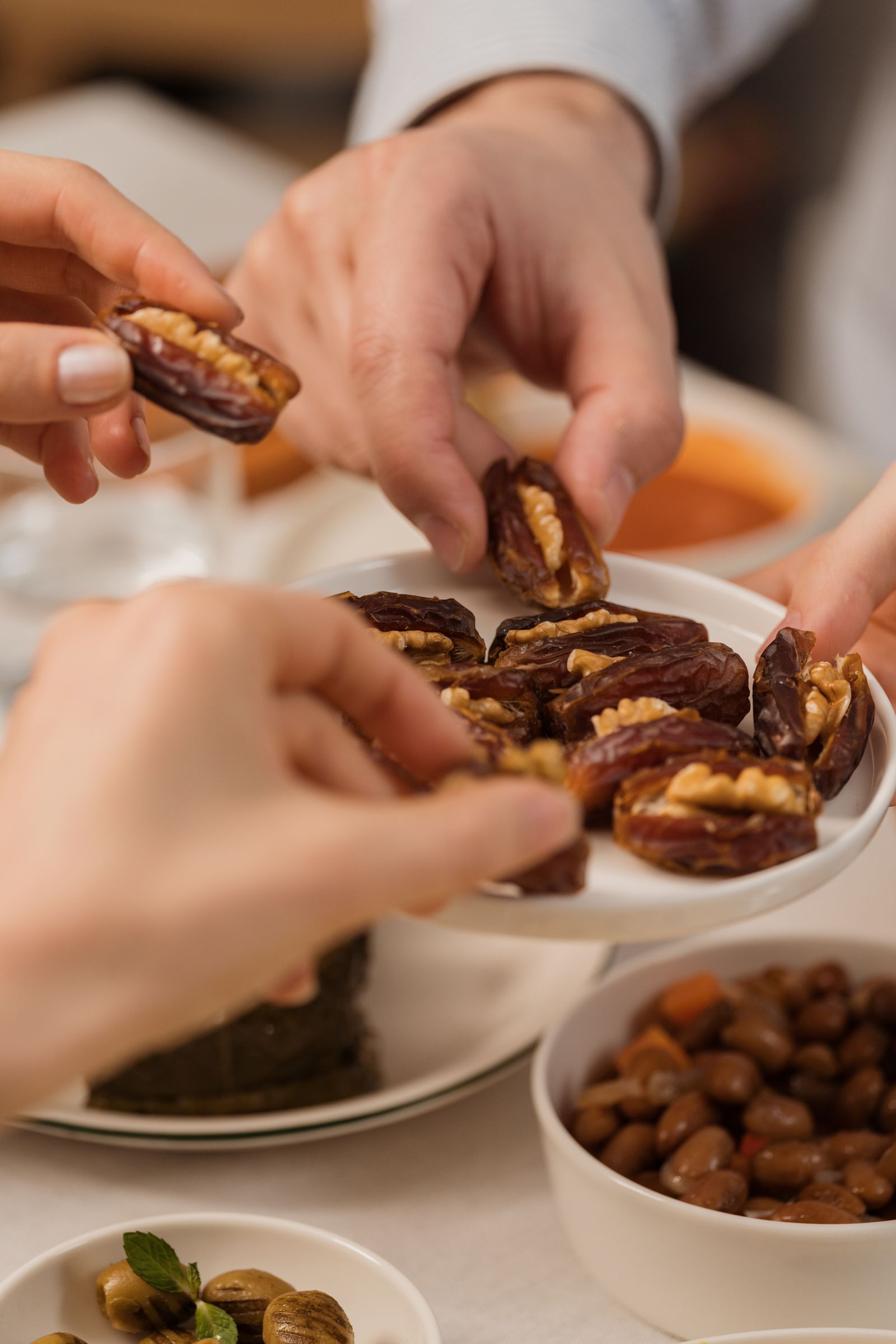
Among them is eating before going to the Eid al-Fitr prayer.
Anas ibn Malik (may Allah be pleased with him) reported that the Prophet ﷺ would not go out on the day of Eid al-Fitr until he had eaten some dates — and that he ate an odd number of them (Sahih al-Bukhari 953).
The day is then marked by the Eid prayer, greetings, visits to relatives and moments of sharing.
Cultural habits naturally vary from one country to another. Meals, clothes, visits and gifts are part of the family and cultural traditions of many Muslim communities, without needing to be presented as religious obligations.
Traditional greetings and wishes
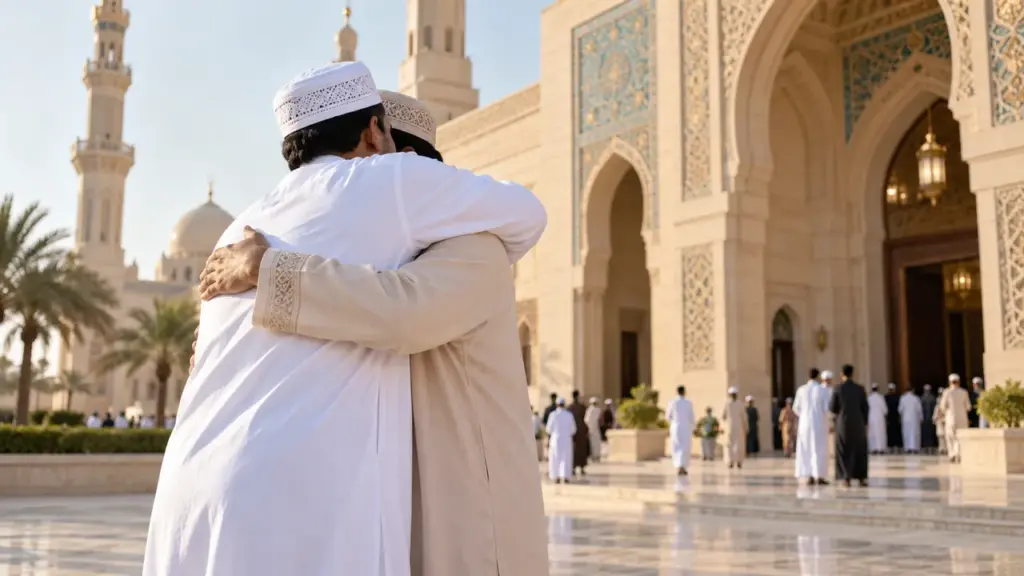
On Eid al-Fitr, Muslims exchange various greetings.
“Eid Mubarak” is very widespread today and can be used to wish someone a blessed festival.
Another well-known formula is “Taqabbal Allahu minna wa minkum”, which means “May Allah accept from us and from you.” It is reported that the Companions exchanged it on the day of Eid.
There is no single, obligatory formula that every Muslim must use. For example, you can write:
“Eid Mubarak to you and your whole family. May Allah accept your worship and grant you peace, happiness and blessings.”
Preparing well for the day of celebration
Preparing for Eid al-Fitr can begin in the last days of Ramadan.
It is useful to plan your zakat al-fitr, prepare your clothes for the festival, organise the family day and check the time of the Eid prayer with your mosque or local authority.
On the eve and the morning of Eid, Muslims also say the takbir abundantly, in line with the practice linked to the end of Ramadan. The Quran says:
“… and that you glorify Allah for having guided you, and that you may be grateful.”
Quran, Surah Al-Baqarah, 2:185.
Eid is also an opportunity to strengthen family ties, visit relatives and share a moment of joy.
For those who go to the prayer or move between different places during the day, a comfortable, practical prayer mat can be useful. This is the case of our foldable prayer mat with backrest, for example in light grey or brown (1 kg, folded into a 39 × 30 cm bag with a handle and shoulder strap).
To deepen your practice, see our guide how to pray in Islam and our article learning to pray.
Frequently asked questions
What was the date of Eid al-Fitr 2026?
In France as in Morocco, Eid al-Fitr 2026 was celebrated on Friday 20 March 2026. The date may differ by a day in other countries depending on the method used to determine the start of Shawwal.
What is zakat al-fitr?
Zakat al-fitr is a charity linked to the end of Ramadan. It was prescribed by the Prophet ﷺ and must be given before the Eid prayer, according to the hadith of Ibn Umar. Its practical details, such as the amount or form of payment, may depend on the legal opinion followed and local authorities.
When should zakat al-fitr be given?
It must be given so that it reaches those in need before the Eid prayer, as reported in the hadith of Ibn Umar. The details of the exact timing differ between schools of law.
Why do we eat before the Eid al-Fitr prayer?
Following the Sunnah: Anas ibn Malik reported that the Prophet ﷺ ate dates, in an odd number, before going out to the Eid al-Fitr prayer.
What do we traditionally say to wish someone a happy Eid?
Common formulas include “Eid Mubarak” and “Taqabbal Allahu minna wa minkum” (“May Allah accept from us and from you”), reported to have been used by the Companions on Eid.
What is the difference between Eid al-Fitr and Eid al-Adha?
Eid al-Fitr marks the end of Ramadan and falls at the beginning of Shawwal. Eid al-Adha, also called Eid al-Kabir in many countries, falls on 10 Dhul-Hijjah, during the pilgrimage season. These are the two annual festivals of Islam.
Can you give gifts on Eid?
Gifts, family meals and visits are part of the cultural habits of many Muslim families at Eid. These customs should be distinguished from the established religious practices: the heart of the day is the Eid prayer, gratitude, greetings and family ties.
Key points
Eid al-Fitr marks the end of Ramadan and is one of the two great annual festivals of Islam.
It is marked by the Eid prayer, zakat al-fitr, eating before the prayer, greetings and reunions with loved ones.
“Eid Mubarak” is widely used to give one’s wishes, while “Taqabbal Allahu minna wa minkum” is reported as a formula exchanged by the Companions on Eid.
Eid is a day of joy, gratitude and sharing, while remaining faithful to the teachings and practices of the Islamic tradition.