Eid Mubarak is a common expression used to wish someone a happy festival on the Muslim feasts. It is used both for Eid al-Fitr, which marks the end of Ramadan, and for Eid al-Adha, the festival of sacrifice.
But what exactly does “Eid Mubarak” mean? Is there a particular formula recommended in the Islamic tradition? And what can you write in a text message, a card or a post to wish your family and loved ones a happy Eid?
This article explains the meaning of “Eid Mubarak”, the main greetings used on Eid and a selection of messages to adapt to each recipient.
Contents
- What does “Eid Mubarak” mean?
- Other traditional Eid greetings
- For which festival can it be used?
- Examples of Eid messages
- Messages by recipient
- Making the most of Eid day
- Frequently asked questions
What does “Eid Mubarak” mean?
The Arabic expression “Eid Mubarak” (عيد مبارك) can be understood as “blessed festival”. “Eid” means festival and “mubarak” conveys the idea of blessing. Today it is widely used by Muslims to exchange wishes on Eid.
It is worth noting that “Eid Mubarak” is not a wording prescribed by the Prophet ﷺ. Eid greetings can be expressed in various permissible ways.
A particularly well-known formula in the Islamic tradition is:
تَقَبَّلَ اللهُ مِنَّا وَمِنْكُمْ
Taqabbal Allahu minna wa minkum — “May Allah accept from us and from you.”
It is reported that the Companions of the Prophet ﷺ exchanged this formula on Eid. It is different from “Eid Mubarak”, which is above all a general greeting.
Other traditional Eid greetings
“Taqabbal Allahu minna wa minkum”
This supplication means “May Allah accept from us and from you”, expressing the wish that Allah accepts the good deeds performed. It is reported as a practice of the Companions when they met on the day of Eid; according to IslamQA (answer 49021), the hafiz Ibn Hajar graded the chain of this report, narrated by Jubayr ibn Nufayr, as “hasan”. It is therefore a formula reported from the Companions, not a wording explicitly commanded by the Prophet ﷺ.
“Eid Mubarak”
“Eid Mubarak” is a general greeting meaning “blessed festival”, suitable for both Eids. Scholars have explained that there is no single obligatory formula for congratulating someone on Eid; any appropriate, permissible wording is fine.
“Eid Sa’id”
“Eid Sa’id” means “happy Eid”. It is common in everyday language and can be used alone or combined, for example: “Eid Sa’id and Eid Mubarak!” What matters is sending a respectful, kind message.
For which festival can it be used?
“Eid Mubarak” can be used for both Eid al-Fitr and Eid al-Adha.
Eid al-Fitr
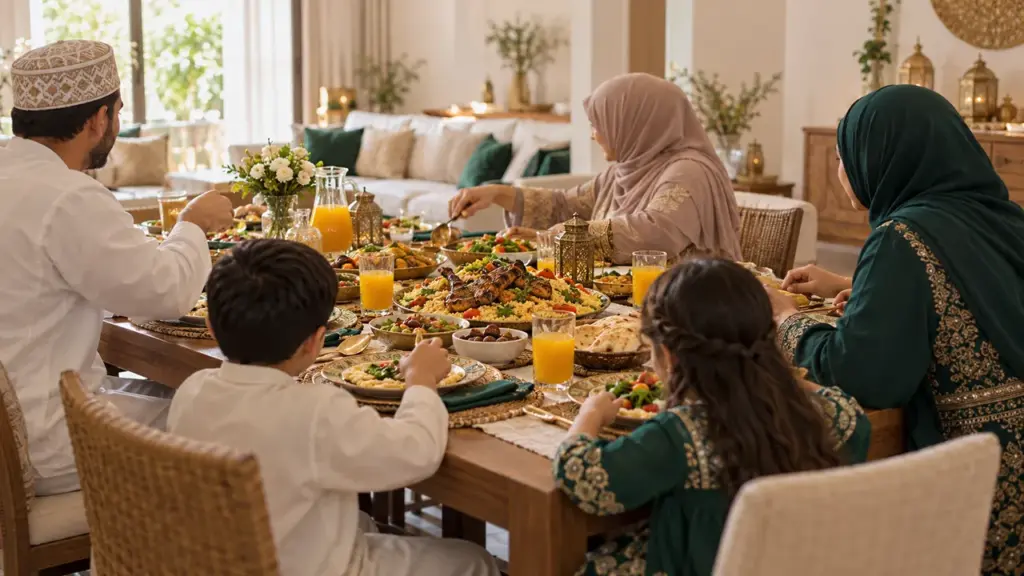
Eid al-Fitr marks the end of the month of Ramadan. It is a day of celebration on which Muslims perform the Eid prayer, gather with family and exchange wishes.
Eid al-Adha
Eid al-Adha, also called Eid al-Kabir in many countries, is the festival of sacrifice. It falls during the days of Hajj and is associated with the ritual sacrifice for those for whom it is prescribed.
In both cases, “Eid Mubarak” is a perfectly suitable general greeting.
Examples of Eid messages
Here are some messages you can adapt to the person you are writing to.
Simple message
“Eid Mubarak! May Allah make this day one of joy, peace and blessings for you and your family.”
Message with a traditional formula
“Taqabbal Allahu minna wa minkum. Eid Mubarak to you and your loved ones. May Allah accept our deeds and grant us His blessings.”
Warm message
“On this festive day, I wish you an Eid full of joy, peace, sharing and wonderful moments with your family. Eid Mubarak!”
Religious message
“Eid Mubarak. May Allah accept our worship, forgive our sins, protect our families and grant us His blessing. Taqabbal Allahu minna wa minkum.”
Short text message
“Eid Mubarak to you and your whole family! May Allah grant you happiness, peace and blessings.”
Message for social media
“Eid Mubarak to everyone! May Allah accept our deeds, grant us His forgiveness and make this festival a time of peace, joy and sharing.”
Messages by recipient
The choice of message can vary depending on who you are writing to.
For the family
“Eid Mubarak to our whole family. May Allah keep us united, protect each one of us and fill our homes with peace, health and blessings.”
For a friend
“Eid Mubarak, my friend! May Allah accept your worship, grant you good and let you spend a wonderful day surrounded by those you love.”
For a colleague or acquaintance
A simple, respectful message is enough: “Wishing you a lovely Eid, full of peace, joy and good moments with your loved ones. Eid Mubarak!”
For a non-Muslim who wants to send their wishes, “Happy Eid!” is also a simple and respectful option.
For your parents
“Eid Mubarak to my dear parents. May Allah protect you, grant you a long life full of goodness and bless your home. Thank you for everything you do for our family.”
For your spouse
“Eid Mubarak to the one who shares my life. May Allah bless our home, strengthen our love and grant us good together in this world and the next.”
How to reply to “Eid Mubarak”?
When someone wishes you “Eid Mubarak”, you can simply reply: “Eid Mubarak to you too!” or “Eid Mubarak to you and your family.” You can also use the formula “Taqabbal Allahu minna wa minkum.”
There is no single obligatory reply. Eid greetings can be expressed in different ways as long as they remain appropriate.
Making the most of Eid day
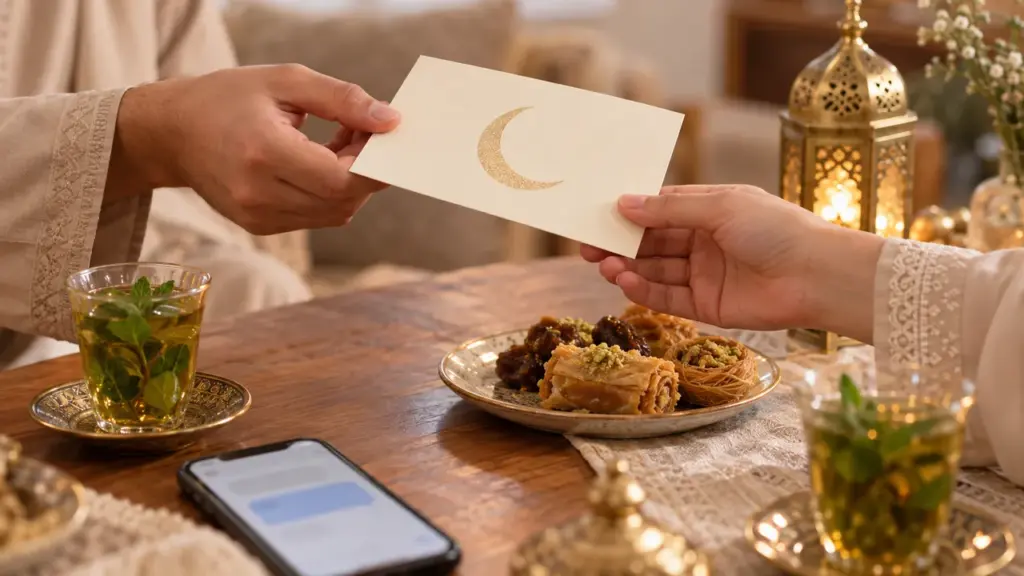
Eid is a day of celebration, gratitude and reunion. Its practices and customs include the Eid prayer, meeting family and loved ones, exchanging greetings and sharing a meal.
It is also recommended to strengthen family ties and to show one’s joy on this festival. After the Eid prayer, Muslims can exchange greetings and supplications, in particular “Taqabbal Allahu minna wa minkum”, reported from the practice of the Companions.
For those who want a mat that is easy to carry when moving around, a foldable, portable prayer mat, such as our black prayer mat or our burgundy prayer mat, can be very practical.
Frequently asked questions
What exactly does “Eid Mubarak” mean?
“Eid Mubarak” generally means “blessed festival”. It is a common greeting for both Eid al-Fitr and Eid al-Adha.
Can you say “Eid Mubarak” for both Eids?
Yes, “Eid Mubarak” can be used for both Eid al-Fitr and Eid al-Adha.
What is the traditional formula reported from the Companions?
تَقَبَّلَ اللهُ مِنَّا وَمِنْكُمْ — Taqabbal Allahu minna wa minkum (“May Allah accept from us and from you”), reported as a practice of the Companions when they met on the day of Eid.
Is “Eid Mubarak” an obligatory formula?
No. There is no single obligatory formula; greetings can be expressed in various permissible ways. “Eid Mubarak” is a common greeting, while “Taqabbal Allahu minna wa minkum” is reported from the Companions.
What should you reply when someone wishes you “Eid Mubarak”?
Simply: “Eid Mubarak to you too!” You can also add a supplication, for example: “May Allah accept our deeds and grant us His blessings.”
Can a non-Muslim wish someone “Eid Mubarak”?
A non-Muslim can wish a Muslim a happy festival respectfully. A simple “Happy Eid!” is perfectly suitable.
What is the difference between “Eid Mubarak” and “Taqabbal Allahu minna wa minkum”?
“Eid Mubarak” is a general greeting meaning “blessed festival”. “Taqabbal Allahu minna wa minkum” is a supplication meaning “May Allah accept from us and from you”, reported as a formula exchanged by the Companions on Eid.
Key points
“Eid Mubarak” is a common way to wish someone a happy Eid al-Fitr or Eid al-Adha. There is no single obligatory formula: Muslims can use any appropriate expression.
Among the formulas reported from the Companions is تَقَبَّلَ اللهُ مِنَّا وَمِنْكُمْ — Taqabbal Allahu minna wa minkum, “May Allah accept from us and from you.”
Whether in a text, a card, a family message or a social media post, what matters is sending your wishes with sincerity, kindness and respect.
Eid Mubarak to all.