Knowing how to pray in Islam is one of the first things every Muslim learns. The salat — the ritual prayer performed five times a day — is the second pillar of Islam. It is obligatory for every adult Muslim of sound mind. Praying correctly means mastering the movements, the words and the preconditions.
Whether you are a beginner, a new convert or want to strengthen your practice, this guide explains step by step how to perform the Islamic prayer: the preconditions (wudu, clothing, qibla), the detailed steps of each rak’ah and the words to say in each position.
Prayer in Islam is a moment of direct connection with Allah. It requires no intermediary and no specific place — you can pray anywhere the ground is clean, for example on a prayer mat. It does, however, require preparation, intention and concentration.
To complement your practice, our guide learning to pray in Islam helps you learn the salat step by step, from the essential surahs to the finer points of recitation.
The Preconditions of Prayer
Before praying, four conditions must be met. Neglecting one of them invalidates the prayer.
1. Ritual purity — wudu (ablution)
Wudu is the ritual purification required before prayer. Its steps:
- Make the intention (niyyah) to perform wudu
- Wash the hands up to the wrists three times
- Rinse the mouth three times
- Rinse the nose three times
- Wash the face three times
- Wash the arms up to and including the elbows three times (right first)
- Wipe the head with wet hands (mash)
- Wipe the ears
- Wash the feet up to and including the ankles three times (right first)
Wudu is broken by answering the call of nature, deep sleep, loss of consciousness and certain discharges. It must then be renewed before praying.
2. Clothing
Clothing must cover the parts of the body that must be covered (’awrah). For men: at least from the navel to the knees. For women: the whole body except the face and hands. Clothes must be clean.
3. Facing the qibla
You must face the Kaaba in Mecca (the qibla). From France, the qibla is roughly south-east. Use a compass or a mobile app to orient yourself precisely — see our guide to finding the direction of Mecca from any city in France.
4. The prayer time
Each prayer must be performed within its prescribed time. Check the prayer times in Paris or in your city so as not to miss any salat.
How to Pray — the Complete Steps
Here is the complete guide, step by step. Each prayer is made up of rak’ahs (units): Fajr has 2, Dhuhr 4, Asr 4, Maghrib 3 and Isha 4.
Step 1 — Intention (niyyah)
Before you begin, form your intention in your heart: “I am performing the [Fajr/Dhuhr/Asr/Maghrib/Isha] prayer for Allah.” The niyyah is an inner decision — it does not need to be said aloud.
Step 2 — Takbirat al-ihram
Standing, feet slightly apart, facing the qibla, raise your hands to the level of your ears or shoulders and say: “Allahu Akbar” (Allah is the Greatest). This is the entry into the prayer — you are now in a state of salat.
Step 3 — Qiyam (standing)
In most schools of law, place the right hand over the left on the chest (in the Maliki school, the arms are commonly left at the sides). Recite Surah Al-Fatiha (obligatory in every rak’ah), then, in the first two rak’ahs, another surah or some verses of the Quran. Al-Fatiha is the pillar of the prayer — without it, the salat is not valid.
Step 4 — Ruku’ (bowing)
Say “Allahu Akbar”, then bow, placing your hands on your knees with your back straight. Say three times: “Subhana Rabbiyal-’Adhim” (Glory be to my Lord, the Magnificent). Rise saying “Sami’a Allahu liman hamidah” (Allah hears whoever praises Him), then “Rabbana wa lakal-hamd” (Our Lord, to You belongs all praise).
Step 5 — The first sujud (prostration)
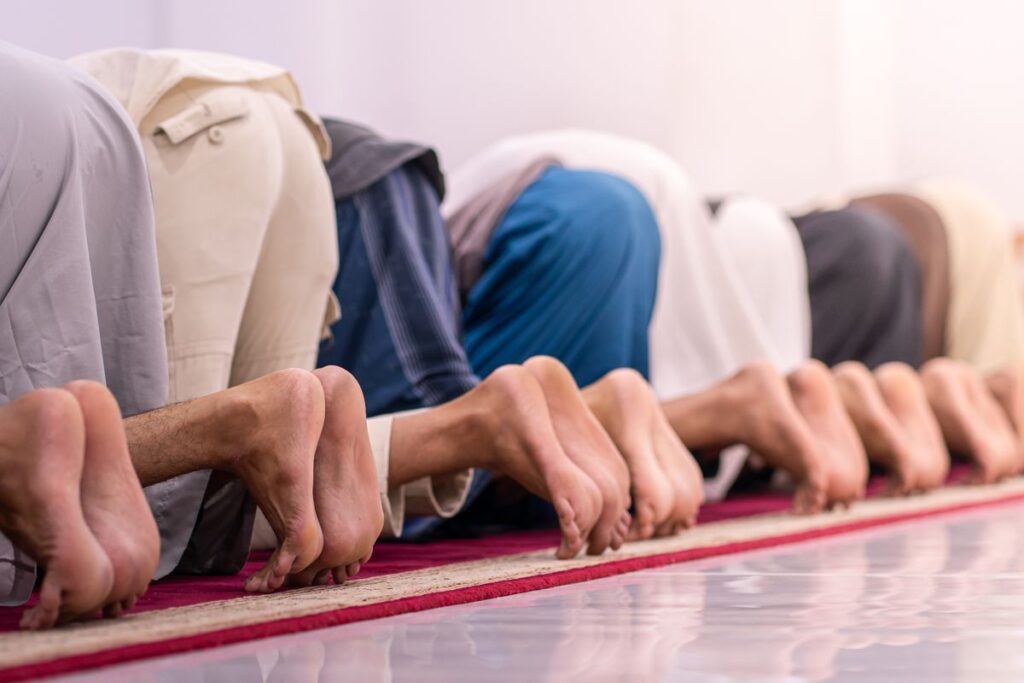
Say “Allahu Akbar” as you go down into prostration. Seven parts of the body touch the ground: the forehead (with the nose), both palms, both knees and the toes of both feet. Say three times: “Subhana Rabbiyal-A’la” (Glory be to my Lord, the Most High).
Step 6 — Julus (sitting)
Rise saying “Allahu Akbar” and sit briefly on your left foot, with the right foot upright. Say: “Rabbighfir li” (My Lord, forgive me). Then go back down for the second sujud, identical to the first. This completes one rak’ah; stand up for the next.
Step 7 — Tashahhud (after the 2nd and the last rak’ah)
After the second sujud of the second rak’ah, remain seated and recite the tashahhud: “At-tahiyyatu lillahi was-salawatu wat-tayyibat. As-salamu ’alayka ayyuhan-nabiyyu wa rahmatullahi wa barakatuh…” Raise the right index finger during the testimony of faith. In the final sitting, add the salawat (blessings on the Prophet ﷺ).
Step 8 — Taslim (closing salutation)
To end the prayer, turn your head to the right saying “As-salamu ’alaykum wa rahmatullah”, then to the left repeating the same words. This is the exit from the prayer.
To learn more surahs and invocations, use reliable resources such as IslamicFinder — Duas.
Why a Prayer Mat Is So Useful for Praying
To pray in the best conditions, the prayer mat is your daily ally. It gives you a clean surface, marks out your prayer space and protects your knees and forehead during prostration.
A good prayer mat should offer:
- A clean, stable surface — so you can pray on any floor
- Enough comfort — for repeated prostrations without pain
- A clear orientation — a design that shows which end faces the qibla
- Practicality — a foldable model goes everywhere: office, travel, mosque
Our foldable prayer mat with backrest is designed for all your daily prayers: its built-in ergonomic backrest supports your back, it weighs 1 kg and folds into a 39 × 30 cm bag with a handle and shoulder strap. The backrest is especially welcome during supplications and seated recitation.
The 5 Daily Prayers — Number of Rak’ahs
Once you know how to pray, you need to know the five obligatory prayers and their number of rak’ahs.
| Prayer | Time | Obligatory rak’ahs (fard) | Main sunnah rak’ahs |
|---|---|---|---|
| Fajr | Dawn, before sunrise | 2 | 2 before |
| Dhuhr | After midday | 4 | 4 before + 2 after |
| Asr | Afternoon | 4 | None among the 12 rak’ahs cited below (some schools recommend rak’ahs before) |
| Maghrib | Sunset | 3 | 2 after |
| Isha | Night | 4 | 2 after, then witr (an odd number, e.g. 1 or 3) |
The sunnah rak’ahs accompany the obligatory prayers. The Prophet ﷺ said: “Whoever prays twelve rak’ahs in a day and night, a house will be built for him in Paradise: four before Dhuhr and two after it, two after Maghrib, two after Isha and two before Fajr” (Jami‘ at-Tirmidhi 415, graded sahih). The number and status of the other voluntary prayers vary between schools. So as never to miss a prayer, our foldable mat, for example in black, goes everywhere with you.
Our AlMuttaki Prayer Mat Selection
At AlMuttaki, our foldable prayer mat with backrest is designed to help you pray comfortably: its built-in ergonomic backrest supports your back, it weighs 1 kg and folds into a 39 × 30 cm bag with a handle and shoulder strap. It comes in six colours, including:
Brown Prayer Mat — the warm one
Our brown prayer mat has a warm, natural shade. Its ergonomic backrest supports you when seated. Ideal for prayer at home.
Black Prayer Mat — the discreet one
Our black prayer mat is sober and elegant, perfect for workplaces and shared spaces. Folded into its 39 × 30 cm bag, it is easy to carry.
Light Grey Prayer Mat — the bright one
Our light grey prayer mat brings a bright touch to your prayer corner. Same model, same features: ergonomic backrest, 1 kg, carrying bag.
Free pick-up point delivery in France from €49 — shipped from France.

FAQ — How to Pray in Islam
How many times a day do Muslims pray?
An adult Muslim performs 5 prayers a day: Fajr (dawn), Dhuhr (midday), Asr (afternoon), Maghrib (sunset) and Isha (night). These five prayers are obligatory and form the second pillar of Islam. Each has between 2 and 4 obligatory rak’ahs.
Can you pray without knowing Arabic?
The words of the prayer (Al-Fatiha, takbirs, tashahhud) are recited in Arabic, the language of the Quran. A beginner who does not yet know Arabic can start with transliteration and learn gradually. What matters is to start and progress step by step. Our guide learning to pray in Islam helps you along the way.
What if I forget a movement or words during the prayer?
If you forget something during the salat, there are prostrations of forgetfulness (sujud as-sahw), performed before or after the final taslim depending on the school of law. If in doubt, ask an imam or a trusted Islamic source.
Is it compulsory to use a prayer mat?
No, using a prayer mat is not an obligation. What is obligatory is that the place of prayer is clean (tahir). The prayer mat helps you pray on a clean surface and makes prostration more comfortable — which is why it is so widely used.
Conclusion
Knowing how to pray in Islam is fundamental knowledge for every Muslim. From wudu to niyyah, from the takbir to the final taslim — every movement and every word has its meaning and its place. The Islamic prayer is at once an act of worship, a daily discipline and a source of inner peace.
With practice and the right equipment, performing the five daily prayers becomes a calm, rooted habit. An ergonomic, foldable prayer mat makes it easier wherever you are — at home, at work or on the move.
Get equipped now and order your AlMuttaki prayer mat to pray in the best conditions. Free pick-up point delivery in France from €49, dispatched within 24–48 working hours.