Learning the Islamic Prayer: A Complete Guide for Children and New Muslims
The basics: why pray?
The importance of salat in Islam
The Islamic prayer, or salat, is the central pillar of Muslim practice after the shahada. Prescribed five times a day, it structures the believer’s day and keeps a constant bond with Allah. The Quran says: “And establish prayer and give zakah, and bow with those who bow” (Surah Al-Baqarah, 2:43). For children and new Muslims, learning the salat is much more than acquiring a religious routine: it means entering a spiritual discipline that guides actions, purifies the heart and brings a sense of inner peace.
Spiritual and psychological benefits
Regular rituals such as daily prayer are widely associated with better emotional balance, less anxiety and a stronger sense of belonging. For children, repeating the movements and invocations develops memory, concentration and respect for spiritual rhythms. For adult converts, the salat becomes an anchor in a new religious identity and a moment of calm amid the challenges of modern life. By making prayer part of their daily lives, beginners nourish both their faith and their wellbeing.
The 5 essential steps of the prayer
Niyyah (intention)
Everything begins with a sincere intention. Before raising their hands, believers form their niyyah in the heart: which prayer they are about to perform, for the sake of Allah. This step is essential. For children it can be simplified: “I am going to pray to be close to Allah.” The intention does not need to be said out loud, but it must be clear in the mind.
Takbirat al-ihram
The prayer officially begins with the takbir: “Allahu Akbar” (Allah is the Greatest). The hands are raised to the level of the ears or shoulders, then — in most schools of law — placed on the chest or abdomen, right hand over left (in the Maliki school they are commonly left at the sides). This gesture marks the passage from everyday life to the inner sanctuary. For beginners, it helps to practise this movement several times at home.
Qiyam, ruku’, sujud
The active part of the prayer consists of three fundamental positions:
- Qiyam: the standing position. Recite al-Fatiha, which is obligatory in every rak’ah, followed in the first two rak’ahs by another surah (such as al-Ikhlas or al-Falaq).
- Ruku’: bowing at the waist, hands on the knees, back straight. Say “Subhana Rabbiyal-’Adhim” (Glory be to my Lord, the Magnificent), usually three times.
- Sujud: prostration. The forehead, nose, hands, knees and toes touch the ground. Repeat “Subhana Rabbiyal-A’la” (Glory be to my Lord, the Most High). According to the Prophet ﷺ, this is when the servant is closest to his Lord (Sahih Muslim 482).
Each movement should be performed calmly and respectfully. For children, it is best to start by learning one rak’ah, then build up gradually.
Tashahhud and salam
At the end of the prayer (after the second rak’ah for Fajr, the third for Maghrib, the fourth for the other prayers), you sit for the tashahhud: you recite the greetings to Allah, the testimony of faith and blessings on the Prophet ﷺ. It begins: “At-tahiyyatu lillahi was-salawatu wat-tayyibat…”. Then you turn your head to the right and then to the left, saying “As-salamu ’alaykum wa rahmatullah” (Peace and the mercy of Allah be upon you). This last step closes the prayer and brings you back to the world, surrounded by peace.
Tips for teaching prayer to children
Use educational mats with a visual guide
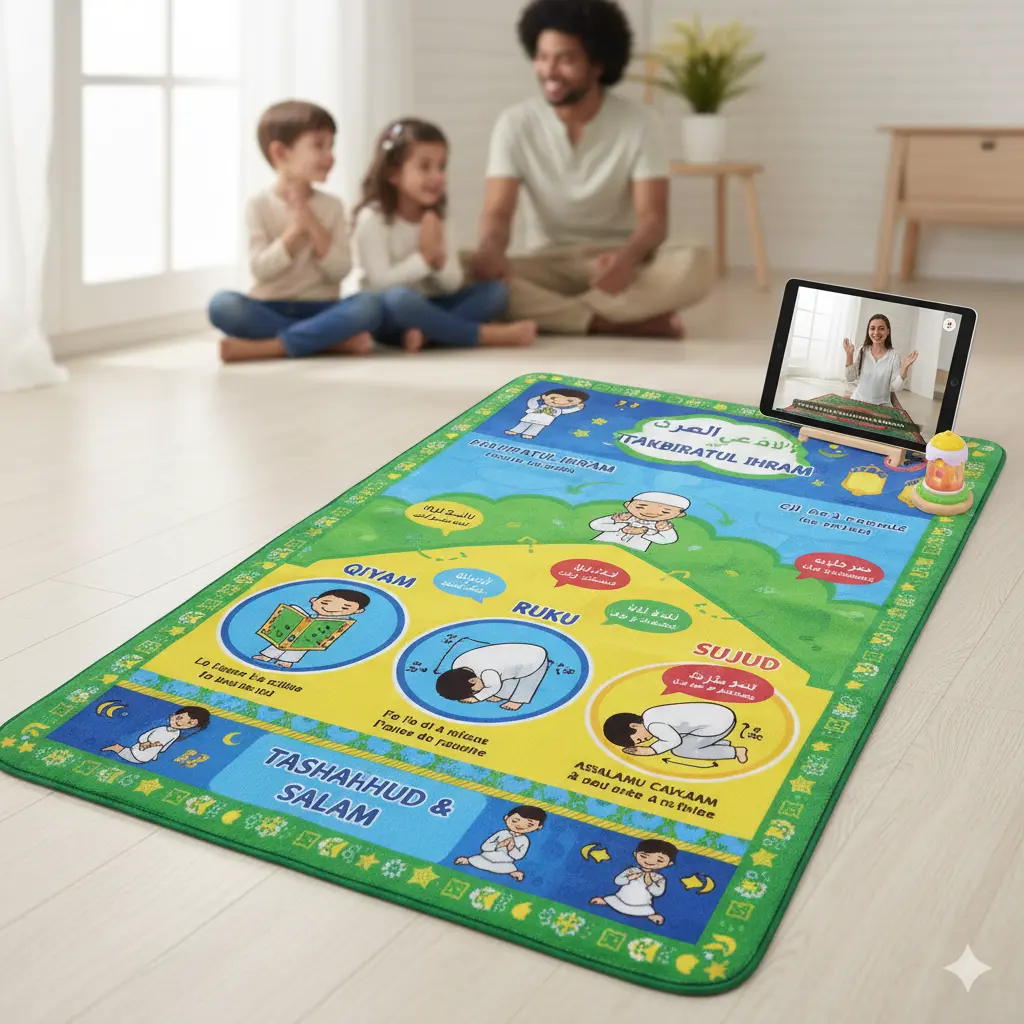
One of the most effective tools for teaching salat to children is the educational prayer mat. Often colourful and marked with symbols or arrows, these mats show the positions (qiyam, ruku’, sujud) and sometimes the key invocations. They turn learning into a sensory game, helping children memorise the movements through visual and tactile repetition. It is a modern teaching method that respects the learning pace of young children.
Make prayer joyful and regular
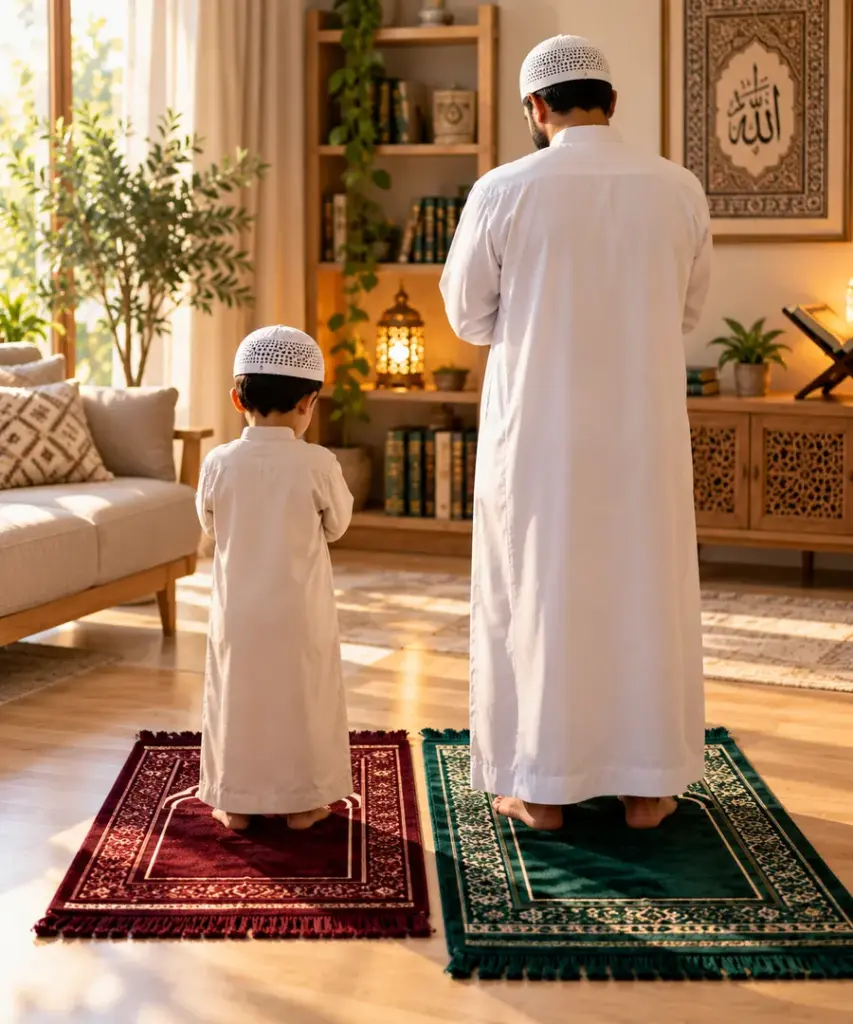
The key to rooting prayer in children is consistency and joy. You can create a family ritual: pray together on Fridays, recite nasheeds after the salat, or give a small symbolic gift after a week of regular prayers. It also helps to tell stories of the Prophet ﷺ about prayer, such as his saying: “The first thing for which a servant will be held accountable on the Day of Resurrection is his prayer” (Jami‘ at-Tirmidhi 413; Sunan an-Nasa’i 465). These stories feed the imagination while boosting motivation.
Additional resources
Mobile apps
Many apps can support beginners as they learn the salat. Look for ones that offer:
- a step-by-step guide with audio, transliteration and simple explanations;
- a children’s mode with animations and small quizzes;
- prayer reminders, local prayer times and help with Arabic pronunciation.
These digital tools are especially useful for families living far from a mosque or Islamic centre.
Explanatory videos with Arabic pronunciation
Educational videos produced by mosques and Islamic schools offer clear, slow demonstrations of the prayer. They let you see each movement, hear the correct pronunciation of the surahs and invocations, and practise at your own pace. For new Muslims they bridge theory and practice, especially when no teacher is available in person — though learning with a qualified teacher or at your local mosque remains the best option.
By combining these resources with a kind, step-by-step approach, learning the salat becomes an enriching experience for every age. Whether you are a parent, a teacher or a convert, this guide gives you the keys to bring the Islamic prayer into your life with serenity and depth.