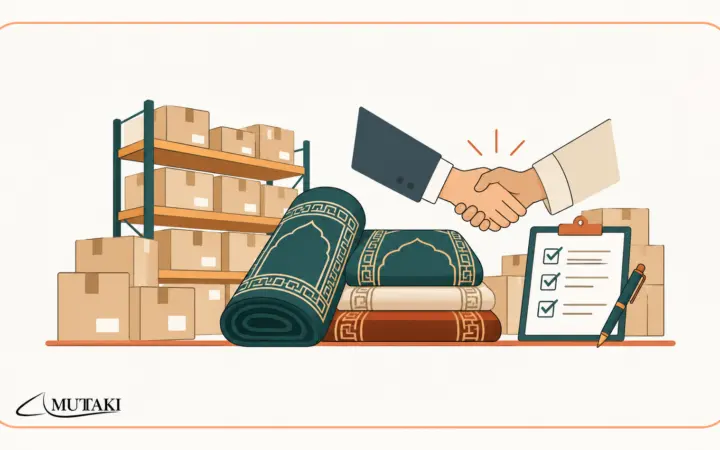

A prayer mat is much more than a simple religious accessory: it is an object full of symbols and traditions, used mainly in Islamic practice to set apart the space of prayer. Designed to provide a clean place dedicated to worship, the prayer mat allows the worshipper to stand, sit, bow and prostrate with dignity. Whether you are new to the faith or seeking to deepen your spiritual connection, understanding the role, meaning and different forms of the prayer mat is valuable.
Used every day by millions of Muslims around the world, the prayer mat marks a moment of reflection, purification and submission to Allah. It is not only a practical support, but a spiritual tool that helps focus the mind, push away distractions and respect the rules of cleanliness (taharah) required for the prayer (salat).
The historical and spiritual origins of the prayer mat
The use of mats for prayer goes back to the earliest days of Islam. The Prophet Muhammad ﷺ prayed on a small palm-fibre mat (khumrah, Sahih al-Bukhari 381) and on woven mats (Sahih al-Bukhari 380), as well as directly on the ground. The idea of a clean, dedicated place for prayer then spread widely. Early prayer mats were simple, made of local materials such as wool, cotton or plant fibres, but they already marked out a space for worship.
Over the centuries, artisans began to add geometric patterns, arches and depictions of mosques or of the Kaaba. These elements recall the oneness of Allah (tawhid), harmony and the beauty of creation — always without images of living beings. In regions such as Persia, Turkey and India, prayer rugs became genuine works of art, hand-woven with skills passed down from generation to generation.
The symbolism of patterns and colours
Each element of a prayer mat has meaning. The mihrab, the arch at the top of the mat, points towards Mecca and represents the direction of prayer (qibla). It guides the worshipper and recalls the unity of the Muslim community (ummah) around a single spiritual centre. Geometric patterns evoke infinity and the order of the universe.
Colours are also often associated with meanings in Islamic art:
- Blue: peace and serenity
- Green: Paradise and life — a colour much loved in Islamic tradition
- Red and burgundy: warmth and strength, very common in traditional rugs
- Gold: light and nobility
Note that it is better to avoid mats bearing Quranic verses or the names of Allah on the part you stand or sit on, since a mat is placed on the floor and stepped on.

The different types of prayer mats
There is a wide variety of prayer mats suited to different needs, cultures and budgets. The main types are:
Traditional prayer rugs
These are often hand-woven, with classic patterns and natural materials such as wool or cotton. Very durable, they are valued for their authenticity and are especially common in the Middle East, North Africa and South Asia.
Modern prayer mats
Designed for contemporary life, these mats are lighter and easier to carry, sometimes padded and foldable, with minimalist designs. Ideal for travellers and city dwellers. Some, like the AlMuttaki mats, even include a backrest for sitting comfortably.
Personalised prayer mats
Increasingly popular, these let you add a name, a date or specific colours. Perfect as gifts for weddings, Eid or other special occasions.
Prayer mats for children
Designed for little ones, these mats often feature colourful illustrations of the prayer positions or the Arabic alphabet. They help introduce children to prayer from an early age in a fun, engaging way.
How to choose the right prayer mat
Choosing a prayer mat depends on several factors: where you pray, your lifestyle, your taste and your budget. A few tips:
- Material: wool is warm and durable, ideal for cold climates; cotton is light and easy to clean; synthetic materials are practical for travel.
- Size: make sure the mat is long enough for you in prostration. For children, smaller models exist.
- Design: choose a design that inspires you without distracting you. A sober design helps you stay focused.
- Portability: if you travel often, choose a light, foldable mat.
It is also best to buy your prayer mat from a trusted source, such as an Islamic bookshop or a specialised website, to guarantee its quality.
Cleaning and purifying the prayer mat
Like everything used for prayer, the prayer mat must be kept clean: purity (taharah) of the place of prayer is a condition of the validity of the salat. A few simple rules:
- Clean your mat regularly with a damp cloth or a soft brush.
- Avoid harsh chemicals that could damage the colours or fibres.
- If the mat is soiled by an impurity (najasah), it must be washed carefully before being used again.
- Store it in a dry, clean place, ideally in a protective cover.
Many Muslims have the good habit of folding their mat after each prayer and keeping it in a clean place, out of respect for this object of worship.
The prayer mat in daily and spiritual life
Beyond its practical role, the prayer mat plays a central part in a Muslim’s spiritual routine. It marks the transition between the outside world and inner life, between worldly concerns and connection with Allah. By unfolding the mat, the worshipper signals to the mind that it is time to turn to prayer.
It also encourages discipline, regularity and concentration. Even outside prayer times, seeing your mat reminds you of the importance of worship in daily life. For families, it is an object that brings people together, especially for prayers at home and on the days of Eid.
Key takeaways
- A prayer mat provides a clean, dedicated place for the Islamic prayer.
- It symbolises purity, the spiritual direction (qibla) and the beauty of faith.
- Its patterns, colours and materials carry meanings rooted in Islamic art.
- There are several types: traditional, modern, personalised and for children.
- Choose according to material, size, design and portability.
- Regular care and cleanliness are essential for the prayer.
FAQ – Prayer mats
Is it compulsory to use a prayer mat to pray?
No. Prayer can be performed on any clean surface, such as an ordinary carpet or a clean floor. The prayer mat is nevertheless much appreciated because it guarantees a clean, dedicated and practical space.
Can you use a prayer mat with figurative designs?
In Islamic tradition, images of humans or animals are avoided on objects related to prayer. Geometric, floral or architectural patterns are preferred, to avoid distraction during prayer.
How do you orient a prayer mat correctly?
The prayer mat should face Mecca, more precisely the Kaaba. Lay it along the axis of the qibla, with the top of the mat (where your head goes) towards Mecca. Use a qibla app or a compass to guide you, especially when travelling or in an unfamiliar place — see our guide to the qibla direction from France.
In short, the prayer mat is much more than a simple rug: it is a spiritual companion, a constant reminder of Allah and a living symbol of the Muslim faith. Whether you want to enrich your own practice or offer a meaningful gift, choosing a quality prayer mat with care and intention is itself an act of devotion.