
Surah Al-Fatiha, the first surah of the Quran, holds a central place in the Muslim prayer. It is recited in the salat and is a particularly important surah in the Islamic tradition.
Made up of seven verses, Al-Fatiha is at once praise addressed to Allah, an affirmation of His oneness and a supplication asking for guidance to the straight path.
This article presents the Arabic text of Surah Al-Fatiha, a translation of the meaning of its verses, its place in the prayer and the virtues reported in the Islamic sources.
Contents
- What is Surah Al-Fatiha?
- The Arabic text of Surah Al-Fatiha
- English translation of the meaning
- Why is it recited in every prayer?
- The virtues of this surah
- Deepening your understanding of Quranic Arabic
- Frequently asked questions
What is Surah Al-Fatiha?
Al-Fatiha, meaning “the Opening”, is the first surah of the Quran. It is also known as Umm al-Kitab (“the Mother of the Book”) and Umm al-Qur’an (“the Mother of the Quran”).
It has seven verses. Allah says about it:
“And We have certainly given you seven of the often-repeated verses and the great Quran.”
Quran, Surah Al-Hijr, 15:87.
Surah Al-Fatiha has a special place in the prayer. It begins with the praise of Allah and the recognition of His attributes, then affirms that worship and the request for help are directed to Him alone. It ends with a plea for guidance to the straight path.
This structure makes Al-Fatiha a complete supplication: the believer begins by praising their Lord, acknowledges His sovereignty and then asks Him for guidance.
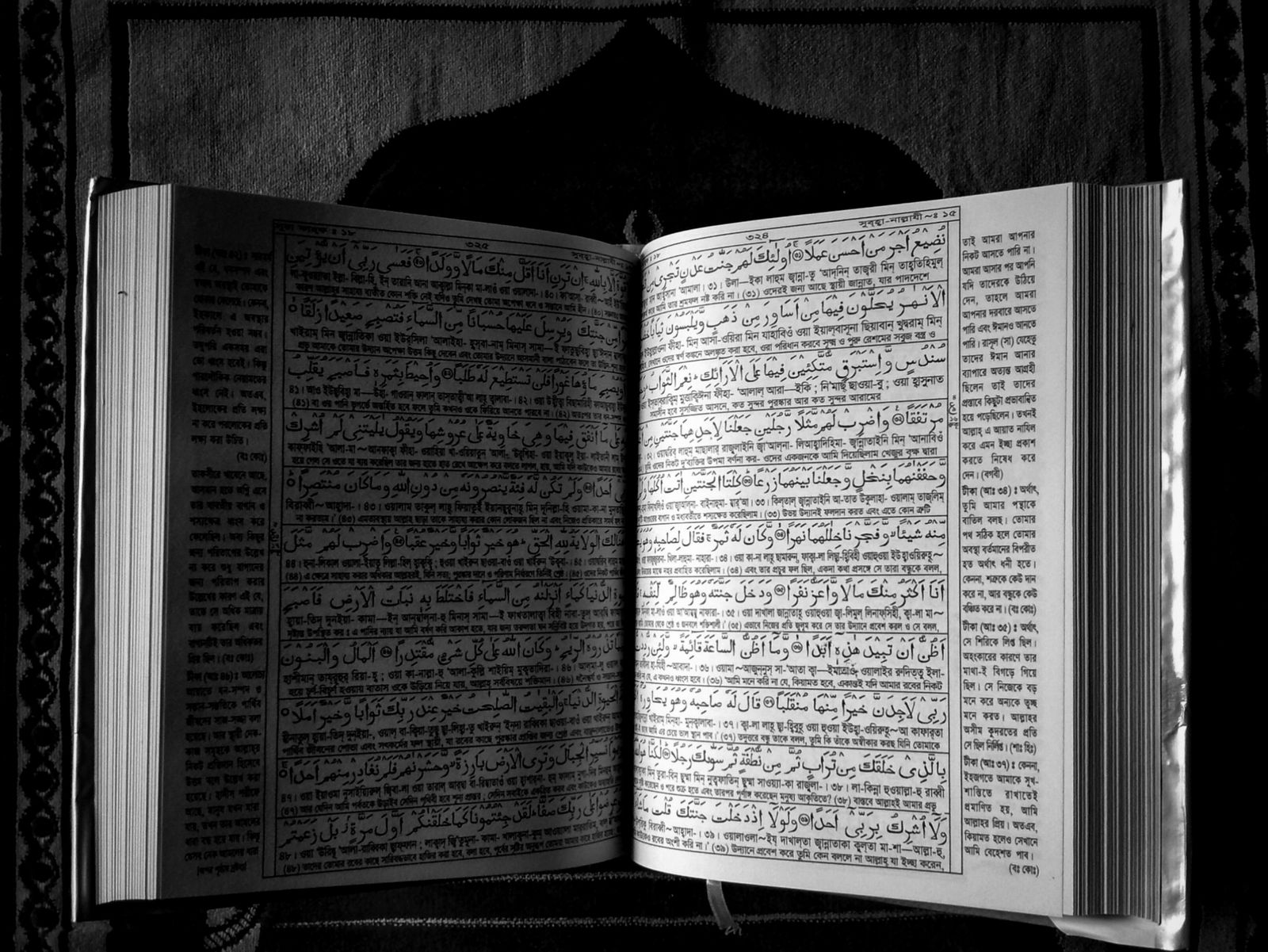
The Arabic text of Surah Al-Fatiha
بِسْمِ اللَّهِ الرَّحْمَٰنِ الرَّحِيمِ
الْحَمْدُ لِلَّهِ رَبِّ الْعَالَمِينَ
الرَّحْمَٰنِ الرَّحِيمِ
مَالِكِ يَوْمِ الدِّينِ
إِيَّاكَ نَعْبُدُ وَإِيَّاكَ نَسْتَعِينُ
اهْدِنَا الصِّرَاطَ الْمُسْتَقِيمَ
صِرَاطَ الَّذِينَ أَنْعَمْتَ عَلَيْهِمْ غَيْرِ الْمَغْضُوبِ عَلَيْهِمْ وَلَا الضَّالِّينَ
After the surah, it is Sunnah to say آمِين (Amin, “O Allah, answer”) — it is not part of the surah itself.
The Bismillah is recited at the beginning of the surah. Whether it counts as a numbered verse of Al-Fatiha differs between schools and traditions of recitation.
For reading the Quranic text, refer to a reliable printed copy of the Quran or a recognised digital source, so as to respect the Arabic script and the rules of recitation precisely.
English translation of the meaning
The meaning of the seven verses can be rendered as follows:
“In the name of Allah, the Entirely Merciful, the Especially Merciful.
All praise is due to Allah, Lord of the worlds,
the Entirely Merciful, the Especially Merciful,
Sovereign of the Day of Recompense.
You alone we worship, and You alone we ask for help.
Guide us to the straight path,
the path of those upon whom You have bestowed favour, not of those who have earned Your anger, nor of those who are astray.”
This translation conveys the general meaning of the verses. Like any translation of the Quran, it cannot perfectly reproduce all the nuances of the Arabic.
The surah covers several fundamental themes: the praise of Allah, His mercy, His sovereignty, exclusive worship, the request for help and the search for guidance.
Why is it recited in every prayer?
Surah Al-Fatiha has an essential place in the prayer. The Prophet ﷺ said:
“There is no prayer for the one who does not recite the Opening of the Book.”
This hadith is reported in particular by Bukhari and Muslim (Sahih Muslim 394a).
Another hadith in Sahih Muslim 395 states that whoever performs a prayer without reciting the Opening of the Book, their prayer is incomplete.
Reciting Al-Fatiha in the prayer is therefore one of the fundamental teachings of the Sunnah. The precise details of this obligation and particular situations (such as praying behind an imam) are discussed differently by the schools of law.
The virtues of this surah
Surah Al-Fatiha has several virtues established in the prophetic tradition.
A particularly important surah
The Prophet ﷺ called Al-Fatiha Umm al-Qur’an and the seven often-repeated verses, which underlines its special place among the surahs of the Quran.
In a few verses it gathers essential themes of faith: the praise of Allah, His mercy, His sovereignty, exclusive worship, the request for help and the search for guidance.
Al-Fatiha and healing through ruqya
An episode reported in Sahih al-Bukhari 5736 tells how a Companion recited Al-Fatiha as ruqya over a man who had been stung or bitten, and he recovered. When the story was reported to the Prophet ﷺ, he approved of this practice.
This account is an important proof for the use of Surah Al-Fatiha in ruqya. It reports a healing within that ruqya and the Prophet’s approval — it does not mean that reciting Al-Fatiha automatically guarantees the cure of every illness.
A surah that combines praise and supplication
Al-Fatiha follows a remarkable progression. It begins with praise: “All praise is due to Allah, Lord of the worlds.” It then recalls Allah’s mercy and sovereignty: “The Entirely Merciful, the Especially Merciful. Sovereign of the Day of Recompense.” Then the believer affirms: “You alone we worship, and You alone we ask for help.” Finally, they ask: “Guide us to the straight path.”
The surah thus combines knowledge of Allah, worship, reliance on Him and the request for guidance.

Deepening your understanding of Quranic Arabic
Memorising Surah Al-Fatiha lets you recite it in the prayer, but understanding its meaning helps you reflect better on the words you say.
Learning Quranic Arabic can help you understand sentence structure, vocabulary and nuances that are hard to convey in translation. Our guide learning Quranic Arabic online presents resources and methods to progress at your own pace.
To understand the prayer as a whole, our article how to pray in Islam is a useful complement.
To accompany your daily prayer and recitation, a comfortable prayer mat, such as our light grey prayer mat, can also add comfort.
Frequently asked questions
Why is Surah Al-Fatiha so important?
Al-Fatiha has a special place in the prayer: the Prophet ﷺ said that there is no prayer for the one who does not recite the Opening of the Book (Sahih Muslim 394a). It also gathers fundamental themes: the praise of Allah, His mercy, His sovereignty, worship and the request for guidance.
How many verses does Surah Al-Fatiha have?
Surah Al-Fatiha has seven verses, in line with the Quranic description of “the seven often-repeated verses” (Al-Hijr, 15:87). Whether the Bismillah is counted as one of them differs between schools and traditions of recitation.
Can you pray without reciting Al-Fatiha?
The authentic hadiths give the recitation of Al-Fatiha a fundamental place in the prayer: “There is no prayer for the one who does not recite the Opening of the Book.” The detailed rulings for someone who does not yet know it, cannot recite it or joins a prayer already in progress are discussed specifically by the scholars.
What does “Al-Fatiha” mean?
Al-Fatiha means “the Opening”, referring to its position at the beginning of the Quran. It is also known as Umm al-Kitab and Umm al-Qur’an.
Can Al-Fatiha be used as ruqya?
Yes. An authentic hadith in Sahih al-Bukhari 5736 reports that a Companion recited Al-Fatiha as ruqya over someone who had been stung or bitten, who then recovered, and the Prophet ﷺ approved this practice. This establishes its use in ruqya, without meaning that its recitation is an automatic guarantee of healing.
How can I better understand the meaning of Al-Fatiha?
Memorisation can be accompanied by learning Arabic vocabulary and reading a reliable translation of the meaning. Understanding phrases such as “All praise is due to Allah, Lord of the worlds”, “You alone we worship” and “Guide us to the straight path” helps you reflect on the surah during prayer.
Key points
Surah Al-Fatiha is the first surah of the Quran and has seven verses. It holds an essential place in the prayer and gathers fundamental themes of faith: the praise of Allah, His mercy, His sovereignty, exclusive worship, the request for help and the search for guidance.
The Sunnah also gives it a special place: the Prophet ﷺ taught its importance in prayer, and an authentic account reports its use as ruqya.
Taking the time to understand Al-Fatiha lets you go beyond memorisation and reflect better on the words you recite every day in prayer.