

The phrase “Subhanallah wa bihamdihi” (سبحان الله وبحمده) is one of the most widespread expressions in Muslims’ spiritual lives. It springs from a deep feeling of admiration, gratitude and thankfulness towards Allah. Beyond its linguistic beauty, this invocation carries a profound meaning and great spiritual rewards. Let us look at what it means exactly, why it holds a central place in religious practice and how it can transform our relationship with Allah.
Definition and translation of “Subhanallah wa bihamdihi”
“Subhanallah wa bihamdihi” translates literally as: “Glory be to Allah, and praise be to Him” (or “Glory be to Allah, with His praise”). It combines two essential elements of glorifying Allah: tasbih (declaring Him free of any imperfection) and hamd (praise). It expresses both Allah’s transcendence — He is above every imperfection — and recognition of His countless blessings.
The Quran uses the same words: “There is nothing that does not glorify Him with His praise (yusabbihu bihamdihi), but you do not understand their glorification” (Surah Al-Isra, 17:44). And Allah commands His Messenger: “So glorify the praise of your Lord (fasabbih bihamdi rabbika)” (Surah An-Nasr, 110:3). Repeating this phrase is therefore joining in the glorification of all creation and remembering our total dependence on Allah.
Authentic hadiths
This invocation is not only popular; it is strongly encouraged in the authentic Sunnah. The Prophet Muhammad ﷺ said:
- “Two words are light on the tongue, heavy on the Scale and beloved to the Most Merciful: Subhanallahi wa bihamdihi, Subhanallahil-’Adhim” (narrated by Abu Hurayrah, Sahih al-Bukhari 6682).
- “Whoever says ‘Subhanallahi wa bihamdihi’ a hundred times a day, his sins will be wiped away, even if they are like the foam of the sea” (narrated by Abu Hurayrah, Sahih al-Bukhari 6405).
- When asked which words are best, he replied: “What Allah has chosen for His angels or His servants: Subhanallahi wa bihamdihi” (narrated by Abu Dharr, Sahih Muslim 2731).
The Quran also repeatedly calls on believers to glorify Allah at all times, for example: “And glorify Him morning and evening” (Surah Al-Ahzab, 33:42). “Subhanallah wa bihamdihi” is a concrete, accessible way to answer this call.
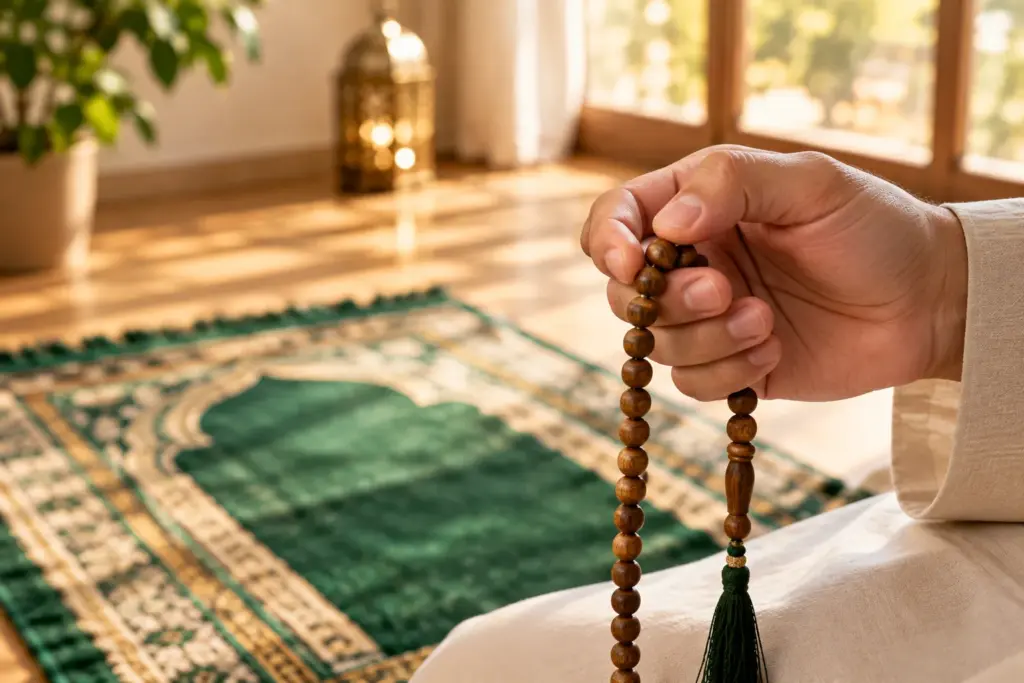
Why repeat “Subhanallah wa bihamdihi”?
Repeating this invocation is not a mere habit. It is an act of faith, a door to inner peace and closeness to Allah. Here is why it deserves a central place in our daily spiritual life:
- It purifies the heart: by recognising Allah’s perfection, we push away pride, envy and ingratitude.
- It strengthens gratitude: every repetition reminds us that all good comes from Allah, cultivating thankfulness (shukr).
- It helps you refocus: replacing doubt or anger with the remembrance of Allah brings the mind back to what matters.
- It is easy to practise: unlike some long invocations, it can be said anywhere, at any time.
A way to remember Allah in every situation
In hardship or joy, fatigue or inspiration, “Subhanallah wa bihamdihi” suits every state of the soul. It becomes a spiritual anchor, a way to turn each moment into worship. When you see a beautiful sunset, you can say it to express your wonder. In times of trial, it becomes a cry of faith: glory to the One who governs all things with wisdom.
Spiritual and psychological benefits
The benefits of this invocation are not only spiritual. They also have a deep effect on the emotional state of those who say it regularly.
1. Inner peace and serenity
When we repeat “Subhanallah wa bihamdihi”, we refocus our attention on Allah’s greatness. This turns the mind away from worldly worries and soothes anxiety. Allah says: “Verily, in the remembrance of Allah do hearts find rest” (Surah Ar-Ra’d, 13:28).
2. Strengthening faith (iman)
Each repetition is an affirmation of faith. We recognise that Allah is perfect, that He deserves all praise and that He is above every weakness. This strengthens inner conviction and protects against doubt.
3. A refuge from stray thoughts
When a stray thought takes hold, returning to the remembrance of Allah (dhikr) helps you refocus your mind. Saying “Subhanallah wa bihamdihi” is a simple way to do so.
4. Accumulating rewards
Each repetition counts as an act of worship. As the hadiths above show, these light words weigh heavily on the Scale and wipe away sins. Even a simple repetition, said sincerely, is recorded and rewarded by Allah.
How to make “Subhanallah wa bihamdihi” part of daily life
To benefit fully, don’t reduce it to a mechanical habit. A few practical tips:
- Include it in your morning and evening adhkar: an authentic hadith mentions saying it 100 times a day (Sahih al-Bukhari 6405).
- Use it as a natural reaction: when you see something beautiful, surprising or difficult, say it spontaneously.
- Say it in quiet moments: while walking, waiting or travelling, let your tongue stay moist with the remembrance of Allah.
- Teach it to children: help them glorify Allah in every situation from an early age.
Key takeaways
- “Subhanallah wa bihamdihi” means “Glory be to Allah, and praise be to Him”, a powerful invocation of glorification and gratitude.
- Its virtues are confirmed by authentic hadiths: beloved to Allah, heavy on the Scale, and it wipes away sins when said 100 times a day.
- It nurtures gratitude, strengthens faith and helps calm the mind.
- Easy to practise, it fits every situation in daily life.
- Repeating it regularly is a simple yet profound way to stay connected to Allah.
FAQ – Frequently asked questions
Is “Subhanallah wa bihamdihi” mentioned in the Quran?
The exact phrase comes from the Sunnah, but the Quran uses the same words: “yusabbihu bihamdihi” (17:44) and “fasabbih bihamdi rabbika” (110:3), among others. The meaning of glorification combined with praise is clearly present.
How many times should it be repeated?
There is no limit, but the authentic hadith mentions 100 times a day for the forgiveness of sins. Even a few times, with sincerity and presence of heart, has great spiritual value.
Can it be said in English, or must it be in Arabic?
The formula taught by the Prophet ﷺ is in Arabic, and that is how it is recommended to say it. Understanding its meaning in English (“Glory be to Allah, and praise be to Him”) helps you say it with presence of heart. On the value of dhikr said in another language, scholars hold different views: for a precise opinion, ask a trusted person of knowledge.
Conclusion
“Subhanallah wa bihamdihi” is not just a phrase. It is a call to awareness, a constant reminder of Allah’s greatness and mercy. By making it part of our daily lives, we turn each moment into an act of worship and each thought into a source of peace. May this invocation become an inner light for you, a refuge in every circumstance and a path to a deeper relationship with your Creator.