The Sacred History of the Prophet’s Mosque and Its Symbolism on the Prayer Mat
Origins and importance of Al-Masjid an-Nabawi
Founded by the Prophet Muhammad ﷺ
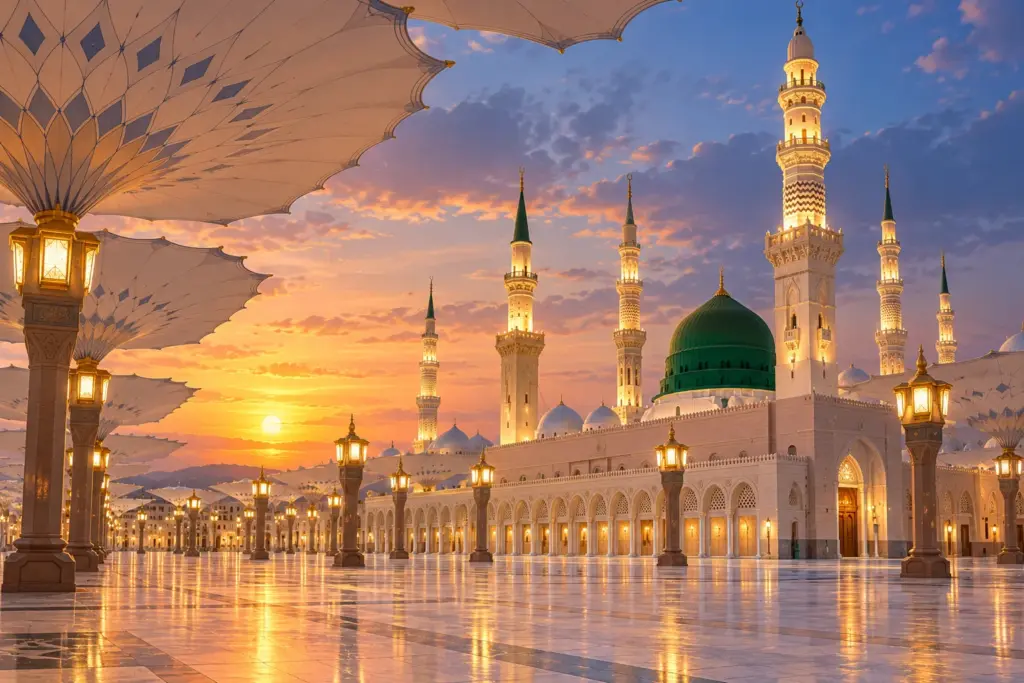
Al-Masjid an-Nabawi, the “Mosque of the Prophet”, was built in 622 CE (year 1 of the Hijrah), when the Prophet Muhammad ﷺ settled in Medina after his migration from Mecca. It was not only a place of prayer but the true spiritual, social and political heart of the first Muslim community. According to the account of Anas ibn Malik, the Companions carried the stones and the Prophet ﷺ was with them, repeating: “There is no good except the good of the Hereafter, O Allah! So forgive the Ansar and the Muhajirun” (Sahih al-Bukhari 428; in Arabic: اللَّهُمَّ لاَ خَيْرَ إِلاَّ خَيْرُ الآخِرَهْ فَاغْفِرْ لِلأَنْصَارِ وَالْمُهَاجِرَهْ).
The original mosque was modest: palm trunks formed the wall facing the qibla (Sahih al-Bukhari 428). After his death in 632, the Prophet ﷺ was buried in the room of Aisha (may Allah be pleased with her), adjoining the mosque, which was later incorporated into it during its extensions. Muslims from all over the world come to pray there today. Today Al-Masjid an-Nabawi is the second holiest mosque in Islam, after the Sacred Mosque in Mecca.
A central role in Islamic history
Beyond its religious function, Al-Masjid an-Nabawi played a fundamental role in organising the young Muslim society. It was there that the Prophet ﷺ led the prayer, taught and delivered his sermons. The mosque was a centre of knowledge, Quranic teaching and justice.
The successive caliphs, notably Umar ibn al-Khattab and Uthman ibn Affan, enlarged it. Its modern extensions now allow it to welcome a very large number of worshippers.
Why depict the mosque on a prayer mat?
A spiritual connection with the heart of Islam
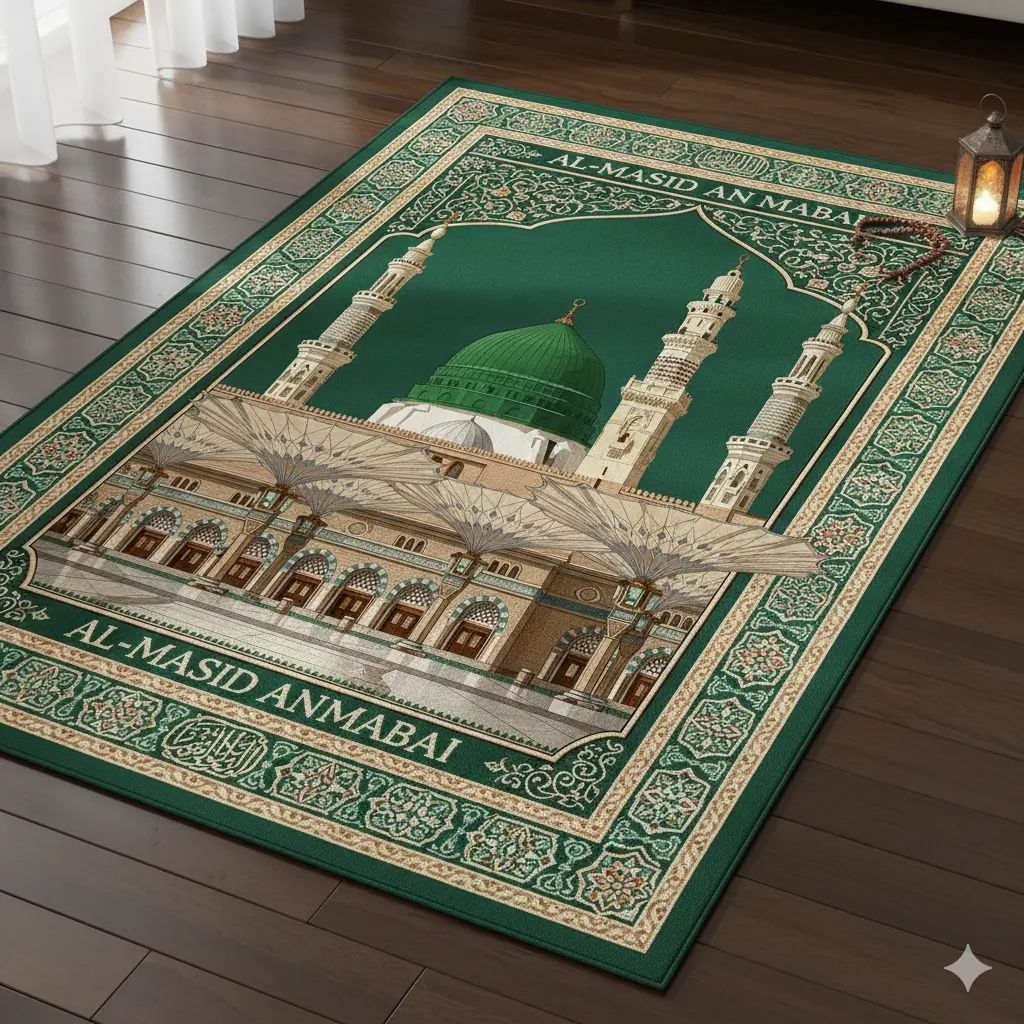
The prayer mat is not just a practical accessory: it is a spiritual tool that turns the soul towards the Divine. When it depicts Al-Masjid an-Nabawi, it becomes a bridge between the worshipper and one of the holiest places in Islam. By placing their hands, forehead and knees on a mat decorated with the Prophet’s Mosque, believers make a symbolic connection with the place where the Messenger of Allah ﷺ lived, prayed and taught.
The prayer (salat) requires a physical orientation towards Mecca, and it also carries a spiritual orientation towards the values that Medina represents: brotherhood, wisdom and closeness to the Prophet’s example. A mat decorated with Al-Masjid an-Nabawi is a reminder that prayer is not only an individual act but also a communal one, rooted in a spiritual heritage of fourteen centuries.
Inspiration for a more focused prayer
The image of the mosque on the mat acts as a constant reminder of the sacredness of the moment of prayer. In a world full of distractions, this visual detail can help refocus the mind, push away stray thoughts and enter a state of khushu’ (humility and concentration). Some scholars, however, advise a sober mat so as not to be distracted: the Prophet ﷺ gave back a garment decorated with patterns, saying that it had distracted him from his prayer (Sahih al-Bukhari 373). Everyone can choose what best helps them concentrate.
For Muslims living far from Medina, this mat also becomes a spiritual window onto the heart of Islam. It helps them feel connected to the city of the Prophet ﷺ despite the distance. And every effort to draw closer to Allah counts, as this hadith qudsi says: “If he draws near to Me by a hand’s span, I draw near to him by an arm’s length; if he draws near to Me by an arm’s length, I draw near to him by a fathom; and if he comes to Me walking, I come to him running” (Sahih al-Bukhari 7405; see also Sahih Muslim 2675).
How this mat can transform your prayer space
Creating a personal sanctuary at home
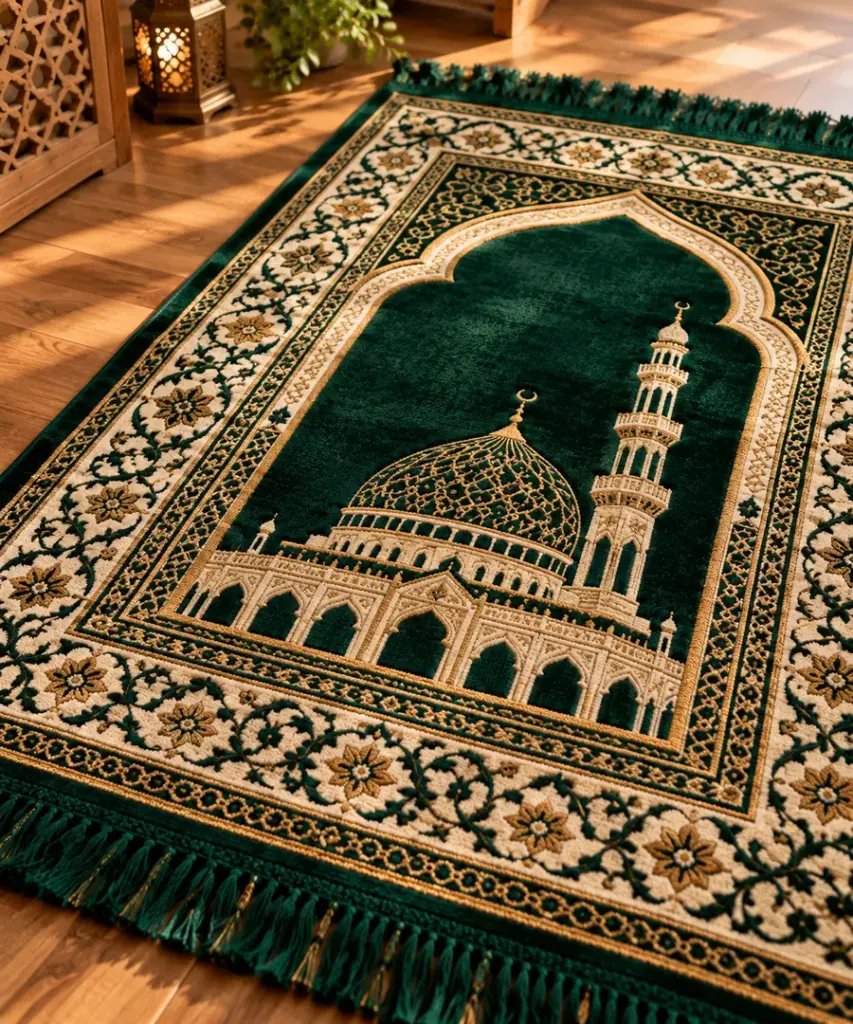
In an age when a fast pace of life makes it hard to set up a space dedicated to spirituality, a prayer mat depicting Al-Masjid an-Nabawi becomes a powerful tool for inner change. By choosing a quality design with fine details and calming colours (greens, golds, deep blues), you create a small sanctuary in your living room, bedroom or office.
The mat acts as a visual and emotional cue: as soon as it is unfolded, it tells the mind that it is time to refocus, purify yourself and connect with Allah. It becomes a daily act of taqwa (piety). To strengthen this effect, place it in a quiet corner away from screens, and add a small lamp for the evening prayers.
A meaningful gift
Giving such a mat means giving much more than an object: it means giving an intention, a blessing, a spiritual reminder. For families living far from the holy places, this gift becomes a cultural and spiritual bridge. It helps pass on to children the importance of Al-Masjid an-Nabawi, not only as a historic place but as a living symbol of Islam.
With the growth of online shops and Muslim artisans, it is now possible to find carefully designed Nabawi prayer mats that respect Islamic aesthetic principles (no human figures, subtle geometric patterns) while featuring the mosque in an artistic and respectful way. These pieces become objects of devotion as well as spiritual works of art.
In short, a prayer mat decorated with Al-Masjid an-Nabawi is not a mere reproduction: it is an invitation to turn your heart towards Medina with every rak’ah. It reminds us that prayer, even when performed thousands of kilometres from the holy places, remains anchored in the same faith, the same direction and the same longing to be close to Allah.