Guide to Greetings and Introductions in Arabic: Essential Expressions
Learning Arabic does not start with verbs or grammar tables — that is a common mistake. The real entry point into this rich, nuanced language is greetings and introductions in Arabic. They are not just polite formulas: they reflect a culture deeply rooted in respect, spirituality and human relationships.
Why mastering Arabic greetings is the first step
Respect for the culture and the Islamic tradition
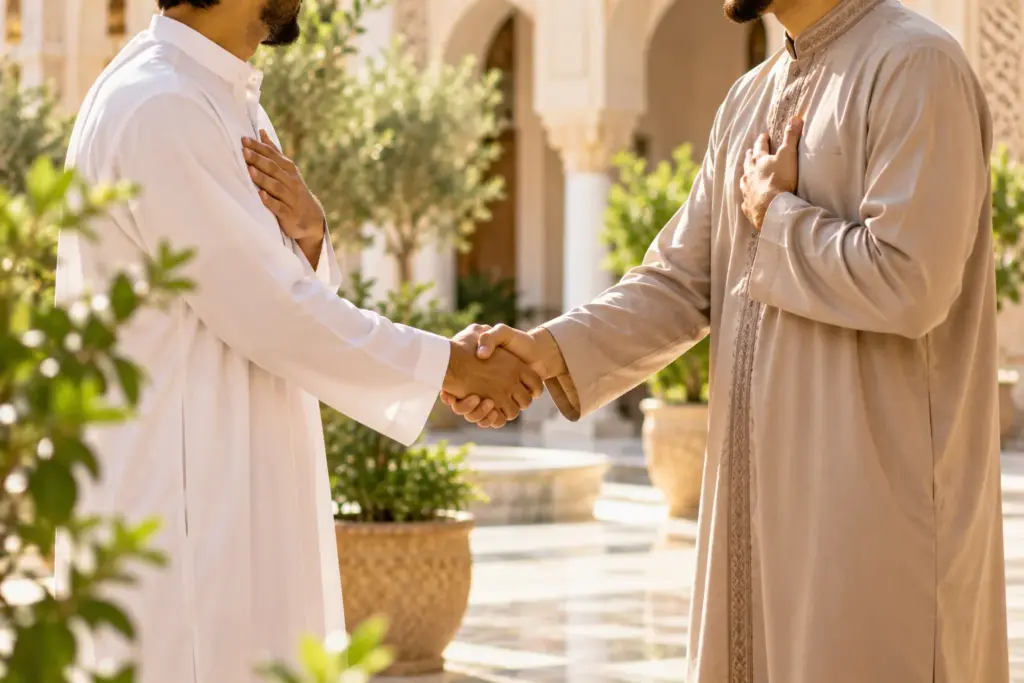
In Arab societies, a greeting is never trivial. The emblematic formula As-salamu ’alaykum (السلام عليكم) literally means “Peace be upon you”. It is the greeting taught by Islam, and “Salam” (Peace) is one of the names of Allah. It is used every day between friends, colleagues and strangers alike. Using it from your first contact shows not only your willingness to learn but also your respect for the values behind the language.
Easier exchanges in Arab countries and in mosques
Whether you travel to Morocco, Egypt or Lebanon, or simply visit a mosque near you, knowing how to greet and introduce yourself in Arabic creates an immediate bond. Native speakers greatly appreciate the efforts of learners, especially when they use the right formula at the right time. For example, saying Sabah al-khayr (صباح الخير) in the morning makes the exchange more natural and warm. A simple interaction becomes a real human connection — essential for learning the language in an authentic setting.
The most common greetings in Arabic
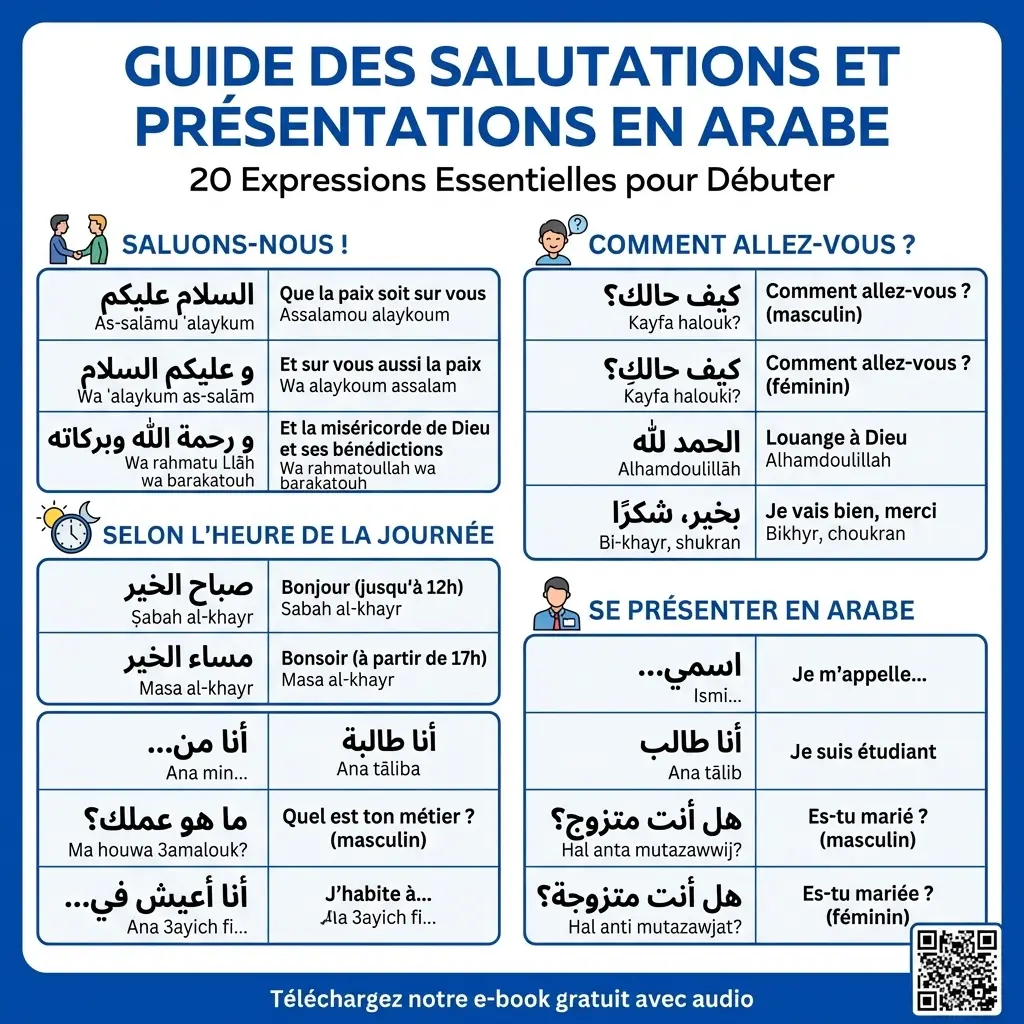
Here are the basic expressions every beginner should know, each with its context of use, since Arabic varies with the time of day, gender and level of formality.
السلام عليكم (As-salamu ’alaykum) – and its reply
This is the universal greeting, used everywhere from Mauritania to the Gulf, to one person or several. The reply is Wa ’alaykum as-salam (وعليكم السلام), “And upon you be peace”. Returning the greeting is an obligation in Islam, and Allah says: “When you are greeted with a greeting, respond with a better one or return it” (An-Nisa, 4:86). You can therefore add wa rahmatullahi wa barakatuh (ورحمة الله وبركاته) — “and the mercy of Allah and His blessings”.
كيف حالك؟ (Kayfa haluk?) – and the forms by gender
Meaning “How are you?”, this question very often follows a greeting. Careful: the form changes with the gender of the person you are speaking to.
To a man: Kayfa haluka? (كيف حالكَ؟)
To a woman: Kayfa haluki? (كيف حالكِ؟)
Typical answers include Al-hamdu lillah (الحمد لله – Praise be to Allah) or Bi-khayr, shukran (بخير، شكرًا – I’m well, thank you). Paying attention to gender is crucial in Arabic and shows a good grasp of the language’s subtleties.
صباح الخير / مساء الخير – depending on the time of day
These two expressions let you adapt your greeting to the time of day:
– Sabah al-khayr (صباح الخير) = Good morning — reply: Sabah an-nur (صباح النور)
– Masa’ al-khayr (مساء الخير) = Good evening (from the afternoon onwards) — reply: Masa’ an-nur (مساء النور)
As-salamu ’alaykum works at any time. These formulas are especially useful in public places, shops and informal meetings.
Other useful everyday expressions
– Ahlan wa sahlan (أهلًا وسهلًا) – Welcome
– Shukran (شكرًا) – Thank you; reply: ’Afwan (عفوًا) – You’re welcome
– Jazak Allahu khayran (جزاك الله خيرًا) – May Allah reward you with good
– Ma’a as-salamah (مع السلامة) – Goodbye
– Tasharrafna (تشرّفنا) – Pleased to meet you

How to introduce yourself in Arabic: key phrases
Once greetings have been exchanged, it is time to introduce yourself. Here are the essential phrases to start any conversation in Modern Standard Arabic (widely understood in all Arab countries).
اسمي… (Ismi…) – My name is…
The basic phrase is Ismi… (اسمي…) followed by your first name. For example: Ismi Karim. To be more polite, you can then add Tasharraftu bi-ma’rifatik (تشرّفت بمعرفتك) – “I’m honoured to meet you”, useful in professional or academic settings.
أنا من… (Ana min…) – I am from…
To say where you come from, use Ana min… (أنا من…) + the name of the country or city. Example: Ana min Baris (I am from Paris). Some regions use local dialect forms, but standard Arabic remains the safest choice for beginners.
أنا طالب / معلّم / مهندس – I am a student / teacher / engineer
To describe your profession or status:
– Ana talib (أنا طالب) – I am a student (male)
– Ana taliba (أنا طالبة) – I am a student (female)
– Ana mu’allim (أنا معلّم) – I am a teacher
– Ana muhandis (أنا مهندس) – I am an engineer
These simple phrases let you build your identity quickly in a conversation, ideal for classes or social exchanges.
Tips to practise and memorise
- Listen to native speakers: videos, podcasts or simply conversations at the mosque help you get the pronunciation right.
- Make a small summary card with the expressions, their transcription and meaning, and keep it in your bag or on your fridge.
- Use them every day: greet people with As-salamu ’alaykum, thank them with Jazak Allahu khayran — practice is what anchors the words.
- Test yourself: say each phrase aloud from memory, then check your answer.
Mastering greetings in Arabic and the basics of introducing yourself is not optional: it is the foundation of successful communication in the Arab world. With this guide, you have what you need to start speaking Arabic with confidence today.