
Saying a dua before sleeping is part of the prophetic tradition. Bedtime is also an opportunity to remember Allah, recite some adhkar and prepare for sleep following the teachings of the Prophet ﷺ.
Several authentic supplications and practices are reported for bedtime, among them a supplication acknowledging that Allah gives life and death, the recitation of certain surahs of the Quran and going to bed after performing wudu.
This article presents the main duas before sleeping and the practices reported in the Sunnah to accompany bedtime.
Contents
- Why make dua before sleeping?
- The main bedtime dua
- Other useful evening recitations
- Recommended practices that accompany these duas
- How to check the authenticity of a dua
- Creating a peaceful evening routine
- Frequently asked questions
Why make dua before sleeping?
The Quran links sleep and death, reminding us that Allah takes the souls at the time of their death, and those that do not die during their sleep:
“Allah takes the souls at the time of their death, and those that do not die during their sleep. Then He keeps those for which He has decreed death and releases the others for a specified term.”
Quran, Surah Az-Zumar, 39:42.
Sleep, which resembles death in this way, can thus be a moment of remembrance and of entrusting oneself to Allah.
The Prophet ﷺ taught several supplications and practices for bedtime. They let you end your day with the remembrance of Allah and follow the Sunnah in the habits of going to bed.
The main bedtime dua
Among the supplications authentically reported for bedtime is:
بِاسْمِكَ اللَّهُمَّ أَمُوتُ وَأَحْيَا
Bismika Allahumma amutu wa ahya
“In Your name, O Allah, I die and I live.”
This supplication is reported in Sahih al-Bukhari and Sahih Muslim. It reminds us that life and death are in Allah’s hands and suits the moment when the believer gives themselves over to sleep.
Another, longer authentic supplication is also reported for bedtime:
اللَّهُمَّ أَسْلَمْتُ نَفْسِي إِلَيْكَ، وَوَجَّهْتُ وَجْهِي إِلَيْكَ، وَفَوَّضْتُ أَمْرِي إِلَيْكَ، وَأَلْجَأْتُ ظَهْرِي إِلَيْكَ، رَغْبَةً وَرَهْبَةً إِلَيْكَ، لَا مَلْجَأَ وَلَا مَنْجَا مِنْكَ إِلَّا إِلَيْكَ…
It begins: “O Allah, I submit my soul to You, I turn my face to You, I entrust my affairs to You and I rely on You…”
The Prophet ﷺ taught this supplication to Al-Bara’ ibn ’Azib (may Allah be pleased with him), advising him to say it when going to bed.
Other useful evening recitations
The Sunnah reports several adhkar to recite before sleep. There is no single obligatory supplication, but several words and recitations taught by the Prophet ﷺ.
Reciting the last three surahs
One of the best-known practices is reciting the last three surahs of the Quran:
- Surah Al-Ikhlas (112)
- Surah Al-Falaq (113)
- Surah An-Nas (114)
’Aishah (may Allah be pleased with her) reported that when the Prophet ﷺ went to bed, he would put his hands together, blow into them and recite Al-Ikhlas, Al-Falaq and An-Nas. He would then wipe his hands over whatever parts of his body he could reach, doing this three times (Sahih al-Bukhari).
Reciting Ayat al-Kursi
Reciting the Verse of the Throne (Ayat al-Kursi, Quran 2:255) before sleeping is reported in an authentic narration from Abu Hurayrah (may Allah be pleased with him): whoever recites it before sleeping will have a protector from Allah, and no devil will come near him until morning (Sahih al-Bukhari).
Reciting the last two verses of Surah Al-Baqarah
The last two verses of Surah Al-Baqarah (2:285–286) also have a special virtue. The Prophet ﷺ said that whoever recites them at night, they will suffice him (Sahih al-Bukhari and Sahih Muslim).
Recommended practices that accompany these duas
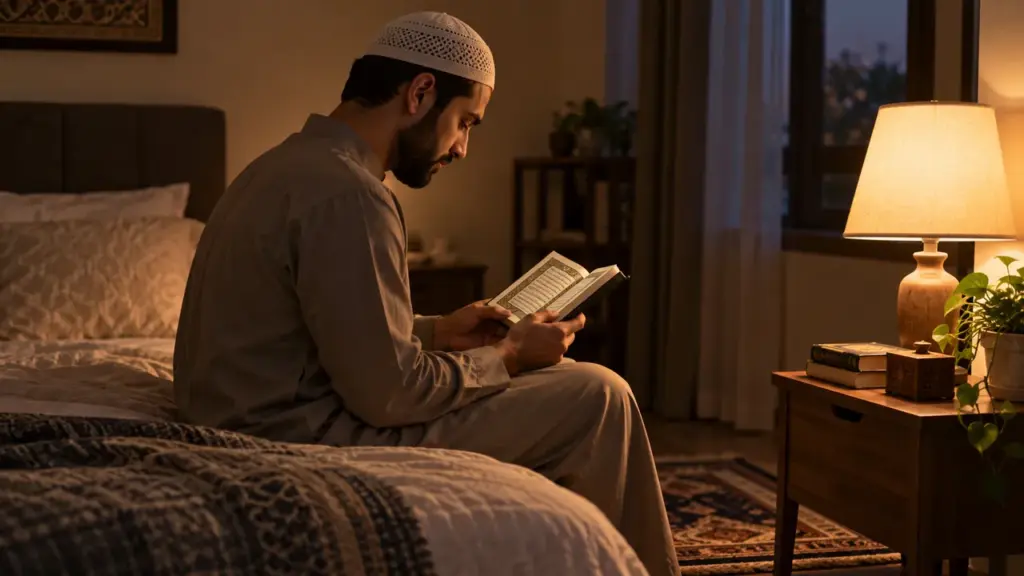
The prophetic teachings on sleep are not limited to supplications.
Performing wudu before sleeping
Al-Bara’ ibn ’Azib reported that the Prophet ﷺ advised him to perform wudu as for prayer before going to bed. This is a recommended Sunnah, not a condition for sleeping.
Sleeping on the right side
In the same hadith, the Prophet ﷺ advised lying down on the right side. This does not mean you must stay on that side all night; it is the recommended position when going to bed.
Shaking out the bedding
The Prophet ﷺ also recommended shaking out one’s bedding with the edge of one’s garment before lying down (Sahih al-Bukhari and Sahih Muslim). This practice is well established in the Sunnah.
Should you sleep facing the qibla?
No specific Sunnah establishes facing the qibla as a rule for sleeping. The recommendation explicitly reported in the hadiths about the bedtime position is to lie on the right side.
How to check the authenticity of a dua
Many supplications circulate online, in videos, posts and images shared on social media. Some are authentic, while others have no reliable source or are wrongly attributed to the Prophet ﷺ.
For a supplication presented as Sunnah, it is important to check its source in recognised hadith collections, including:
- Sahih al-Bukhari
- Sahih Muslim
- Sunan Abu Dawud
- Jami’ at-Tirmidhi
- Sunan an-Nasa’i
- Sunan Ibn Majah
It is also useful to check the grading of the hadith when a supplication is attributed to the Prophet ﷺ.
An important precaution is to distinguish an authentically reported dua from a personal supplication. A Muslim may call upon Allah in their own words within what is permitted, but a personal wording should never be presented as a prophetic saying without proof.
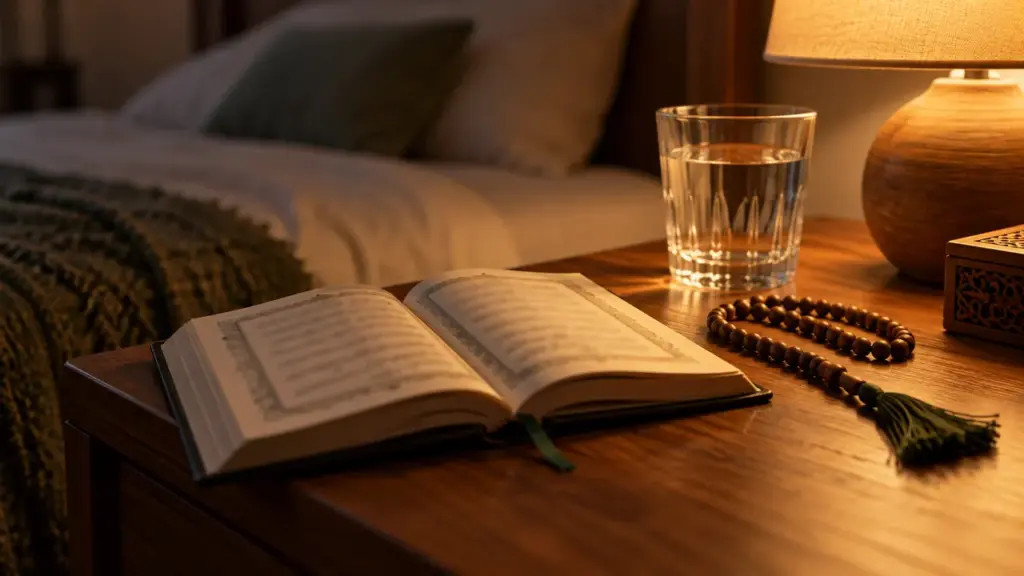
Creating a peaceful evening routine
Bedtime can become a regular opportunity to draw closer to Allah. A simple routine might include:
- Performing wudu before going to bed.
- Shaking out your bedding.
- Lying on your right side.
- Reciting the authentically reported adhkar and supplications.
- Reciting Al-Ikhlas, Al-Falaq and An-Nas.
- Reciting Ayat al-Kursi.
- Reciting the last two verses of Surah Al-Baqarah.
- Ending with the bedtime dua.
There is no need to turn this routine into a rigid personal obligation. The aim is to follow the authentic teachings as much as possible and end your day with the remembrance of Allah.
For those who like to spend a few minutes in prayer or reflection before sleeping, a comfortable prayer mat, such as our dark grey prayer mat, can make this routine even more pleasant.
Frequently asked questions
What is the best-known dua before sleeping?
Among the authentically reported supplications is “Bismika Allahumma amutu wa ahya” — “In Your name, O Allah, I die and I live” (Sahih al-Bukhari and Sahih Muslim).
Why recite the last three surahs before sleeping?
The Prophet ﷺ recited Al-Ikhlas, Al-Falaq and An-Nas before sleeping. ’Aishah reported that he blew into his hands after reciting them, wiped them over his body and did this three times (Sahih al-Bukhari).
Should Ayat al-Kursi be recited before sleeping?
Reciting Ayat al-Kursi (2:255) before sleep is reported in an authentic narration in Sahih al-Bukhari, which mentions protection until morning for whoever recites it before sleeping.
Is it recommended to sleep on the right side?
Yes. The Prophet ﷺ advised Al-Bara’ ibn ’Azib to perform wudu and then lie on his right side when preparing to sleep.
Should you perform wudu before sleeping?
Performing wudu before going to bed is a recommended practice reported in the Sunnah. It is not an obligation for sleeping.
Should you sleep facing the qibla?
There is no established specific Sunnah of sleeping facing the qibla. The explicitly reported recommendation for bedtime is to lie on the right side.
Can you make a personal dua before sleeping?
Yes, you can call upon Allah in your own words within what is permitted. But when a supplication is presented as a dua taught by the Prophet ﷺ, it is important to check that it is reported in a reliable source.
What should be recited before sleeping to seek Allah’s protection?
Authentically reported recitations include Al-Ikhlas, Al-Falaq and An-Nas, as well as Ayat al-Kursi. The last two verses of Surah Al-Baqarah are also reported to have a special virtue at night.
Key points
Bedtime supplications are part of the adhkar reported in the Sunnah. The Prophet ﷺ taught several words and practices for bedtime, including:
- “Bismika Allahumma amutu wa ahya”: “In Your name, O Allah, I die and I live.”
- Reciting Al-Ikhlas, Al-Falaq and An-Nas three times.
- Reciting Ayat al-Kursi.
- Reciting the last two verses of Surah Al-Baqarah.
- Performing wudu before bed.
- Lying on the right side.
- Shaking out the bedding before lying down.
These practices let you end the day with the remembrance of Allah and follow the prophetic teachings on sleep.
What matters is to distinguish authentically reported supplications from formulas simply shared online, so as not to attribute to the Prophet ﷺ words whose authenticity is not established.